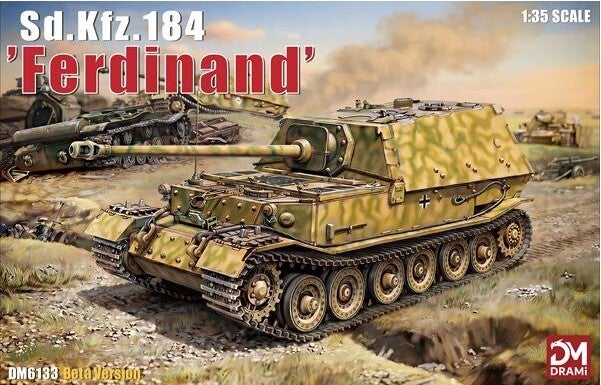
DRAMi : REF : 6133 : 1:35 : German : Sd.Kfz. 184 ("Ferdinand") (BETA VERSION)
DRAMi (PREVIOUSLY DRAGON) :
6126
Manufacturer :
DRAMi.
GTIN : pending.
Scale :
1:35
---
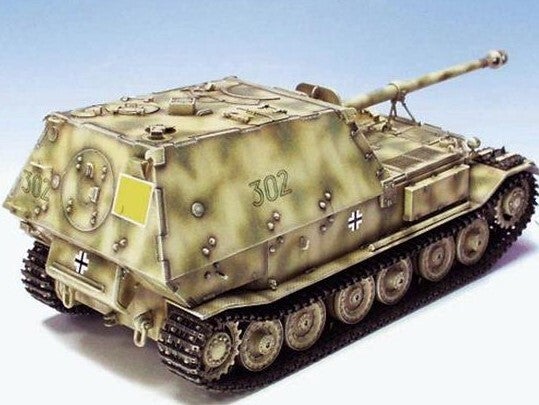
Plastic model kit for building an Sd.Kfz. 184 Ferdinand.
Scale 1:35.
Includes tank soldier figures.
single link tracks.
3 marking options.
Unassembled, unpainted.
Paint and glue not included.
The Sd.Kfz. 184 Ferdinand was a heavy German tank destroyer from the Second World War. Its powerful 8.8 cm gun and heavy frontal armor made it dangerous at long range. However, its high weight, limited mobility, and complex maintenance requirements significantly restricted its operational value.
In the 1942 competition to develop the "Tiger" heavy tank, the Porsche design - the VK 45.01 (P) - lost to the Henschel model. The Porsche chassis that had already been manufactured subsequently served as the basis for this tank destroyer. In the spring of 1943, approximately 90 vehicles were produced at the Nibelungenwerk plant in St. Valentin; they were initially designated "Ferdinand," named after Ferdinand Porsche. In July 1943, they saw their first major combat deployment during Operation "Citadel" in the Kursk region, serving with the 653rd and 654th Heavy Tank Destroyer Battalions.
In early 1944, the remaining vehicles were overhauled and improved, receiving additions such as a hull-mounted machine gun and a commander's cupola. Throughout 1944–1945, these vehicles - now designated "Elefant" - were deployed in Italy and on the Eastern Front. Small remaining stocks were still in combat in 1945.
Differences:
1) Ferdinand (1943) :
-Close-in defense: No fixed hull-mounted machine gun.
-Commander’s vision: Simple roof hatch, limited field of view.
-Main armament: 8.8 cm PaK 43/2 L/71.
-Other changes: original version.
2) Modernized Elefant (1944).
-Close-in defense: 7.92 mm MG 34 in a ball mount.
-Commander’s vision: raised commander’s cupola with vision devices.
-Main armament: 8.8 cm PaK 43/2 L/71 (Same).
-Other changes: includes improved protective grilles and Zimmerit coating.
---
Maquette en plastique à assembler d'un Sd.Kfz. 184 Ferdinand.
Échelle 1/35.
Inclut des figurines de soldats.
Chenilles constituées de maillons individuels.
3 options de marquage.
À assembler et à peindre.
Peinture et colle non incluses.
Le Sd.Kfz. 184 Ferdinand était un chasseur de chars lourd allemand de la Seconde Guerre mondiale. Son puissant canon de 8,8 cm et son épais blindage frontal le rendaient redoutable à longue distance. Cependant, son poids élevé, sa mobilité limitée et la complexité de son entretien ont considérablement restreint sa valeur opérationnelle.
Lors du concours de 1942 visant à développer le char lourd « Tiger », le projet proposé par Porsche — le VK 45.01 (P) — fut écarté au profit du modèle de Henschel. Les châssis Porsche déjà fabriqués servirent par la suite de base à la conception de ce chasseur de chars. Au printemps 1943, environ 90 exemplaires furent produits à l'usine Nibelungenwerk de St. Valentin ; ils furent initialement baptisés « Ferdinand », en hommage à Ferdinand Porsche. En juillet 1943, ils connurent leur premier engagement majeur lors de l'opération « Citadelle », dans la région de Koursk, au sein des 653e et 654e bataillons de chasseurs de chars lourds.
Début 1944, les véhicules restants furent révisés et améliorés, recevant notamment une mitrailleuse de caisse et un tourelleau pour le chef de char. Tout au long des années 1944-1945, ces engins — désormais désignés « Elefant » — furent déployés en Italie et sur le front de l'Est. Quelques exemplaires furent encore engagés au combat en 1945.
---
Différences :
1) Ferdinand (1943) :
-Défense rapprochée : Absence de mitrailleuse fixe montée en caisse.
-Vision du chef de char : Trappe de toit simple, champ de vision limité.
-Armement principal : Canon PaK 43/2 L/71 de 8,8 cm.
-Autres caractéristiques : Version originale. 2) Elefant modernisé (1944).
- Défense rapprochée : mitrailleuse MG 34 de 7,92 mm montée sur rotule.
- Observation du chef de char : tourelleau surélevé équipé de dispositifs de vision.
- Armement principal : canon PaK 43/2 L/71 de 8,8 cm (inchangé).
- Autres modifications : ajout de grilles de protection améliorées et d’un revêtement Zimmerit.
---