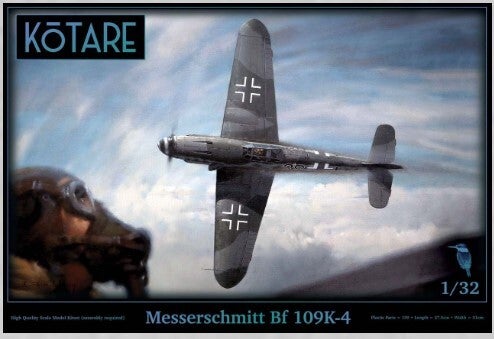
KOTARE MODELS : REF : K32009 : 1:32 : AIRCRAFT KIT : German : MESSERSCHMITT : Bf 109K-4
KOTARE REF :
K32009
Manufacturer :
KOTARE (NEW ZEELAND)
GTIN : 09413000124330.
Scale :
1:32
---
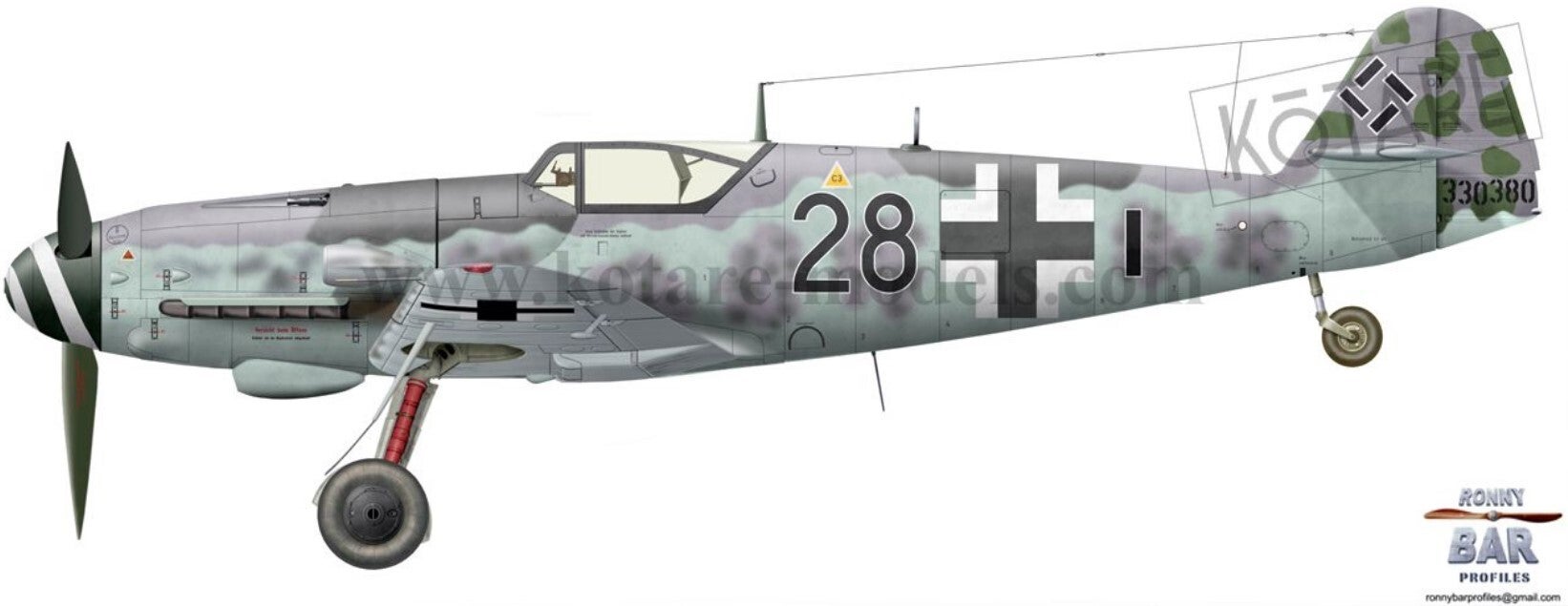
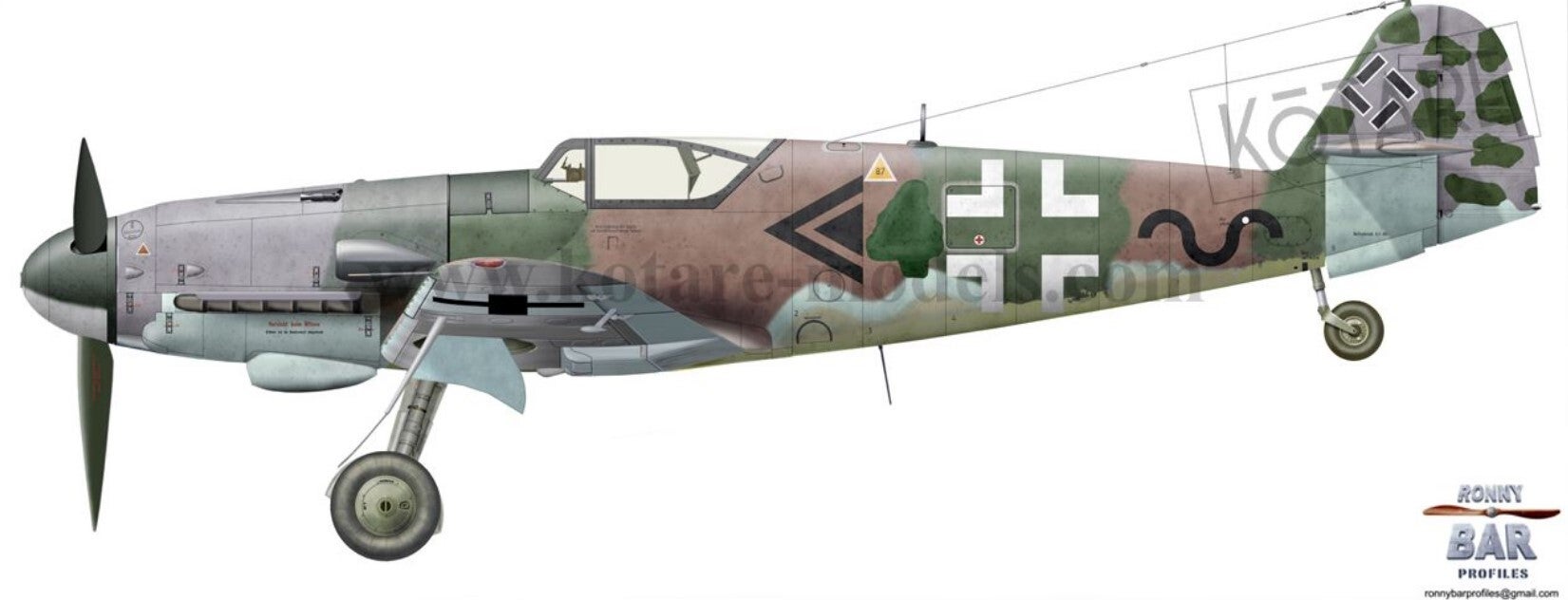
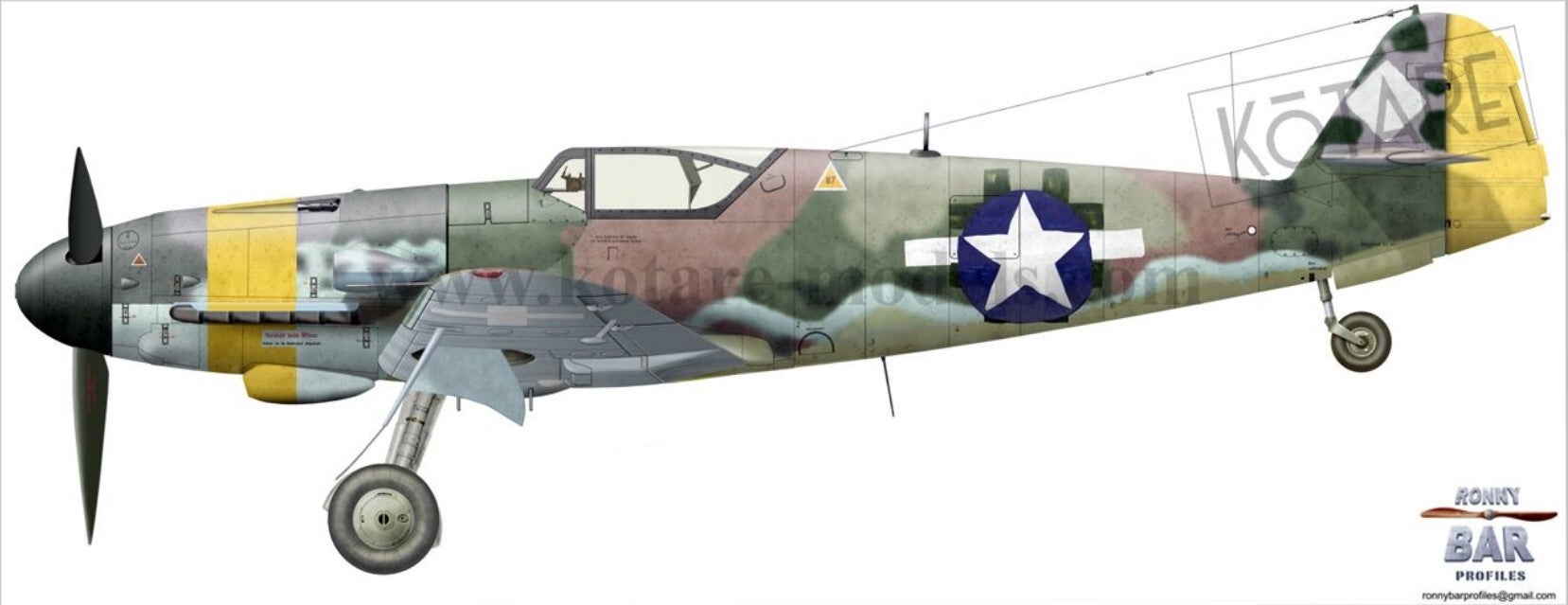
Released on 21 July 2025 - 139 high-quality injection moulded plastic parts. 31cm wingspan. All new tooling. Includes early and late production instrument panels, aerial mast, and rudders. Optional deployed and retracted slats, flaps, radiator doors, R6 camera, seats with and without moulded in safety harness detail, tall and low tailwheel struts, tailwheel doors open, wired shut and built shut, drop tank and carrier, open and closed canopies, windscreen coaming air intakes, outer undercarriage doors, wooden and metal horizontal tailplanes, and compass hatch. Wheels with weighted tyres featuring correct alignment. Fully illustrated instruction manual. High quality Cartograf decals for 3 early and late production Bf 109K-4 from 1945.
---
By 1944 the fame of the Messerschmitt Bf 109 in aviation history was assured forever. Produced in vast numbers and operating in a dozen war theatres, the Bf 109 had shot down more enemy aircraft than any other aeroplane. As the Nazi war machine ran riot in 39-42 the 109 became a feared symbol of Hitler’s regime, and was justly renowned for its lethal attributes in air combat.
However in mid 1944 it would have been fascinating to have a heart-to-heart conversation about the 109 with Messerschmitt AG part-owner and namesake Willi Messerschmitt.
On the one hand he was selling thousands of Bf 109Gs to the Nazi government via the Reichsluftfahrtministerium (RLM) and making good profit on them. This was partly achieved by the unconscionable use of slave labour in horrific conditions. On the other hand his engineers had completely failed to design a successful piston engine replacement for the 109. The 209 and 309 had become ignominious failures.
The ongoing competition with Kurt Tank at Focke-Wulf for single-seat fighter dominance was in full swing. It appears that very little information was shared between Messerschmitt and Focke-Wulf, either directly or via the RLM, but the Fw 190D was in flight testing by mid-1943 and was showing great promise, and the apex Focke Wulf of the war, the Ta 152, was in development.
Messerschmitt’s reputation had been badly damaged by the Me 210 debacle, and while the Me 410 was a serviceable aeroplane, it was no great advance on the Me 110 and was found wanting when P-51s roamed the German skies. The revolutionary Me 262, possibly the most beautiful aeroplane ever, had been hijacked by Hitler and his bomber obsession and the Jumo engines were a constant headache. The science fiction Me 163 was too temperamental for even gifted pilots to use effectively, and while incredibly fast was going nowhere tactically or strategically. Messerschmitt’s Me 264 “Amerika Bomber” consumed vast amounts of engineering resource for no visible result.
In this environment the Bf 109K was born.
Like Supermarine with the Spitfire (but unlike Hawkers) the Messerschmitt engineers had squeezed progressively more powerful engines into an airframe that first f lew in 1935, and didn’t change much at all. Always a handful to land and take off with its narrow-track undercarriage, this characteristic was only emphasized by the increased power on tap.
One major change from the early 109G models was the adoption of much bigger tyres. This was necessary due to the need to cope with the increasing weight of the aircraft, particularly to allow the fitment of bigger brakes. Improved ground handling was an ancillary benefit. This necessitated a bulged upper wing skin, but rather than use circular or oval bulges like the Spitfire and earlier 109s did, long-chord rectangular bulges were fitted. Remarkably these had been aerodynamically tested pre-war in the aeronautical research institute near Braunschweig, one of the most advanced in the world in 1939.
For most aircraft designs, increasing engine power leads to the need for bigger vertical tail surfaces and the 109 was no exception. A tail of greater area had already been used on some Gs, and this became standard on the K, with an attempt to preserve precious aluminium by having sub-contractors use wood as much as possible.
Daimler Benz had worked miracles to wring up to 1775 horsepower from their DB 605 engine, which was produced in slightly different versions to suit either 87 or 96 octane fuel. Water-methanol injection was standard, used to cool the fuel-air mixture in the engine cylinders and reduce pre-detonation, therefore allowing increased power for short periods of time. The methanol also stopped the water from freezing at altitude. The DB 605 D was the intended motor for the K-4, and the oil cooler and nose contours were designed to suit.
In an attempt to improve aerodynamic cleanliness outer doors were fitted to enclose the main gear, and a retractable tail wheel was fitted. Despite being first tested on the Bf 109F in 1941, the main gear doors were still not reliable in 1944, and many machines had them removed. Reliability issues also affected the tail wheel which was often fixed in the extended position and the doors wired shut.
In many respects the K can be seen as a developmental offshoot of the attempt by Messerschmitt and Daimler Benz to develop a true high altitude fighter (Höhenjager) to combat high-altitude USAAF bombers and P-51s. The Me 109H proved abortive, and the competing Focke-Wulf Ta 152 was a much better aeroplane, though it arrived too late to affect the course of the war
Many other less obvious K-4 features will be called out at the relevant points in this instruction booklet.
COMBAT SERVICE
It is a cliche, because it is true, that Allied bombing didn’t really cut off the supply of aircraft to the Luftwaffe in 44-45, it cut off the supply of fuel. The simultaneous ascent of the P-51 as the dominant fighter in the sky (ably assisted by a variety of other Allied aircraft) meant that German pilots were not safe anywhere. The clumsy Luftwaffe training scheme, which had never been as efficient as the Allied pilot-training effort, was overwhelmed.
It is commonly accepted that the K-4 entered service in October 1944 and in a few months the various factories supplied over 1400 machines to Luftwaffe units. How many of them were ever flown, let alone flew in combat, will never be known. However units across both the Western and Eastern fronts received the latest 109, and a few were even supplied to ANR units still fighting on the Axis side in Italy.
Mixed units of Gs and Ks seems to have been common, and it is doubtful that any Allied pilot, Western or Russian, would have known which version they were fighting in the air unless a turning combat ensued and the overwing bulges were obvious, and even then some G model aircraft had these.
Few first-person accounts of what it was like to fly the 109K-4 seem to have survived. There is little evidence that it was viewed as a major improvement over the G, but pilots must have been aware of which version they were climbing into because of the substantial cockpit differences. There are a few accounts describing a well-made and fully-functioning K in capable hands being able to hold its own against most Allied fighters, but the halcyon days of 1940-42 were long gone. In most instances the limited known combat records detail a sad story of losing many inexperienced pilots against overwhelming numbers of enemy aircraft flown by seasoned flyers.
Despite this, the aura of the Bf 109K still exists. It was the culmination of a decade of development by one of the foremost aircraft manufacturers in the world. In the last year of the war no Allied pilot would have taken on a 109 without respect, and in the hands of an ace the K was still a killer.
---
Sortie le 21 juillet 2025 - 139 pièces en plastique injecté de haute qualité. Envergure de 31 cm. Outillage entièrement nouveau. Comprend les tableaux de bord des versions début et fin de production, le mât d'antenne et les gouvernails. Options : becs de bord d'attaque déployés et rétractés, volets, portes de radiateur, caméra R6, sièges avec ou sans harnais de sécurité moulé, jambes de roulette de queue hautes et basses, portes de roulette de queue ouvertes, fermées par fil de fer ou par le châssis, réservoir largable et son support, verrières ouvertes et fermées, prises d'air de pare-brise, portes de train d'atterrissage extérieures, empennages horizontaux en bois et en métal, et trappe de compas. Roues avec pneus lestés et alignement correct. Manuel d'instructions entièrement illustré. Décalcomanies Cartograf de haute qualité pour 3 Bf 109K-4 (versions début et fin de production) de 1945.
---
Dès 1944, la renommée du Messerschmitt Bf 109 dans l'histoire de l'aviation était assurée à jamais. Produit en très grand nombre et utilisé sur une douzaine de théâtres d'opérations, le Bf 109 a abattu plus d'avions ennemis que tout autre appareil. Alors que la machine de guerre nazie faisait des ravages entre 1939 et 1942, le 109 devint un symbole redouté du régime hitlérien et acquit une renommée justifiée pour son efficacité redoutable au combat aérien.
Cependant, au milieu de l'année 1944, il aurait été fascinant d'avoir une conversation franche à propos du 109 avec Willi Messerschmitt, copropriétaire et fondateur de Messerschmitt AG.
D'un côté, il vendait des milliers de Bf 109G au gouvernement nazi par l'intermédiaire du Reichsluftfahrtministerium (RLM) et en tirait de substantiels profits. Ces profits étaient en partie dus au recours inadmissible au travail forcé dans des conditions épouvantables. De l'autre côté, ses ingénieurs avaient complètement échoué à concevoir un moteur à pistons de remplacement efficace pour le 109. Les 209 et 309 furent des échecs retentissants.
La compétition acharnée qui opposait Messerschmitt à Kurt Tank chez Focke-Wulf pour la suprématie des chasseurs monoplaces battait son plein. Il semble que très peu d'informations aient été partagées entre Messerschmitt et Focke-Wulf, que ce soit directement ou par l'intermédiaire du RLM. Cependant, le Fw 190D était en essais en vol dès le milieu de l'année 1943 et se montrait très prometteur, tandis que le fleuron des Focke-Wulf de la guerre, le Ta 152, était en cours de développement.
La réputation de Messerschmitt avait été fortement ternie par le fiasco du Me 210. Si le Me 410 était un appareil fonctionnel, il ne représentait pas une avancée majeure par rapport au Me 110 et se révéla insuffisant face aux P-51 qui sillonnaient le ciel allemand. Le révolutionnaire Me 262, sans doute l'un des plus beaux avions jamais conçus, avait été accaparé par Hitler et son obsession pour les bombardiers, et ses moteurs Jumo constituaient une source constante de problèmes. Le Me 163, avion de science-fiction, était trop capricieux pour être utilisé efficacement, même par les pilotes les plus talentueux. Malgré son incroyable vitesse, il n'offrait aucun avantage tactique ou stratégique. Le Me 264 « Amerika Bomber » de Messerschmitt a englouti des ressources d'ingénierie considérables sans résultat tangible.
C'est dans ce contexte que le Bf 109K a vu le jour.
À l'instar de Supermarine avec le Spitfire (mais contrairement à Hawker), les ingénieurs de Messerschmitt avaient intégré des moteurs de plus en plus puissants dans une cellule dont le premier vol remontait à 1935, sans y apporter de modifications majeures. Déjà difficile à piloter au décollage et à l'atterrissage en raison de son train d'atterrissage à voie étroite, cette difficulté était accentuée par la puissance accrue.
L'une des principales évolutions par rapport aux premiers modèles 109G fut l'adoption de pneus beaucoup plus larges. Cette modification était nécessaire pour compenser le poids croissant de l'appareil, notamment pour permettre l'installation de freins plus imposants. L'amélioration de la maniabilité au sol constituait un avantage secondaire. Cela nécessitait un revêtement supérieur d'aile bombé, mais plutôt que d'utiliser des renflements circulaires ou ovales comme sur le Spitfire et les premiers 109, on opta pour des renflements rectangulaires à longue corde. Fait remarquable, ces derniers avaient été testés aérodynamiquement avant-guerre à l'institut de recherche aéronautique près de Braunschweig, l'un des plus avancés au monde en 1939.
Pour la plupart des avions, l'augmentation de la puissance du moteur implique le besoin d'empennages verticaux plus grands, et le 109 ne faisait pas exception. Un empennage de plus grande surface était déjà utilisé sur certains G, et il devint standard sur le K, avec un effort pour préserver le précieux aluminium en demandant aux sous-traitants d'utiliser autant que possible le bois.
Daimler Benz avait réalisé des prouesses techniques pour extraire jusqu'à 1 775 chevaux de son moteur DB 605, produit en versions légèrement différentes pour fonctionner avec du carburant à indice d'octane 87 ou 96. L'injection d'eau-méthanol était de série. Elle servait à refroidir le mélange air-carburant dans les cylindres du moteur et à réduire le cliquetis, permettant ainsi une augmentation de puissance pendant de courtes périodes. Le méthanol empêchait également l'eau de geler en altitude. Le DB 605 D était le moteur prévu pour le K-4, et le refroidisseur d'huile ainsi que le profil du nez furent conçus en conséquence.
Afin d'améliorer l'aérodynamisme, des portes extérieures furent installées pour protéger le train d'atterrissage principal, et une roulette de queue rétractable fut ajoutée. Bien qu'ayant été testées pour la première fois sur le Bf 109F en 1941, les portes du train d'atterrissage principal restaient peu fiables en 1944, et de nombreux appareils furent privés de ces portes. Des problèmes de fiabilité affectaient également la roulette de queue, souvent bloquée en position sortie.
---
Sources : Kotare Website.