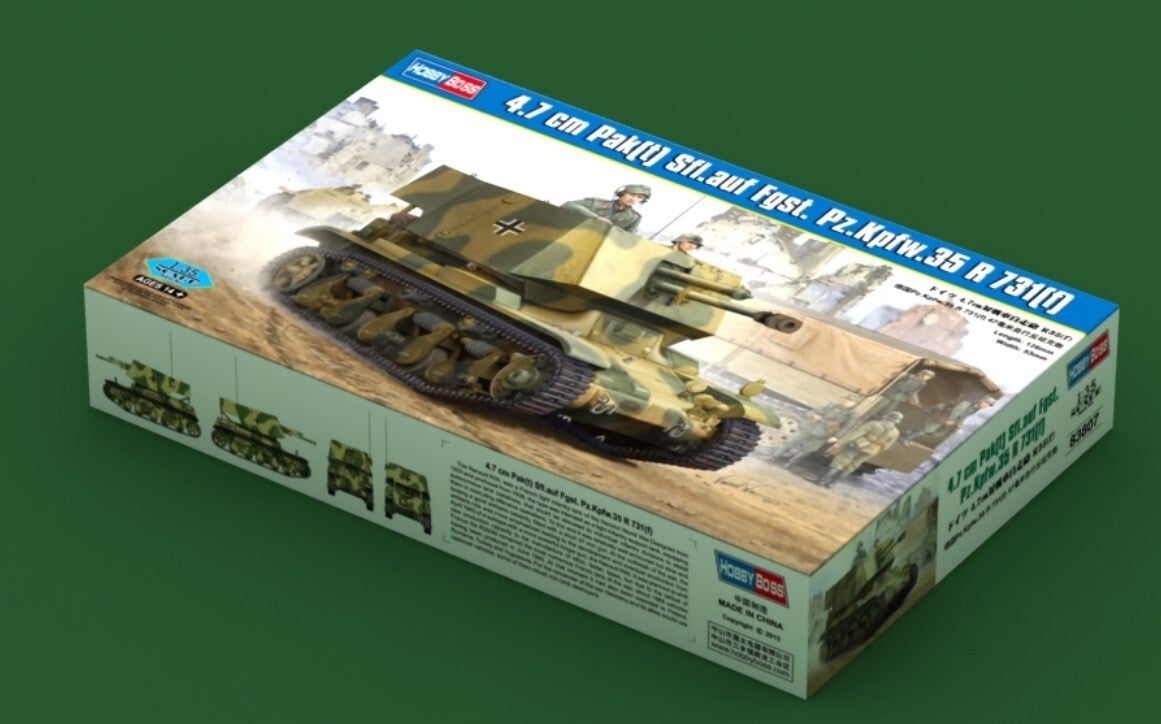
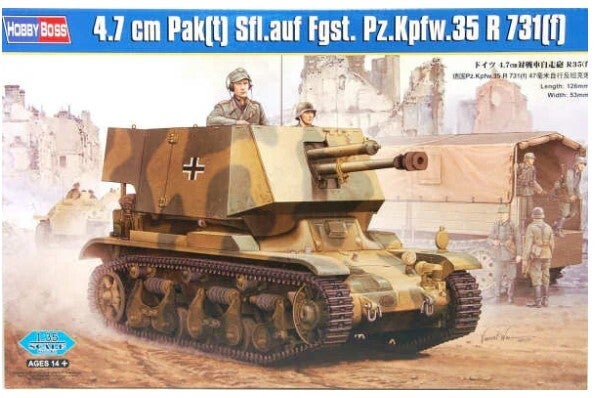
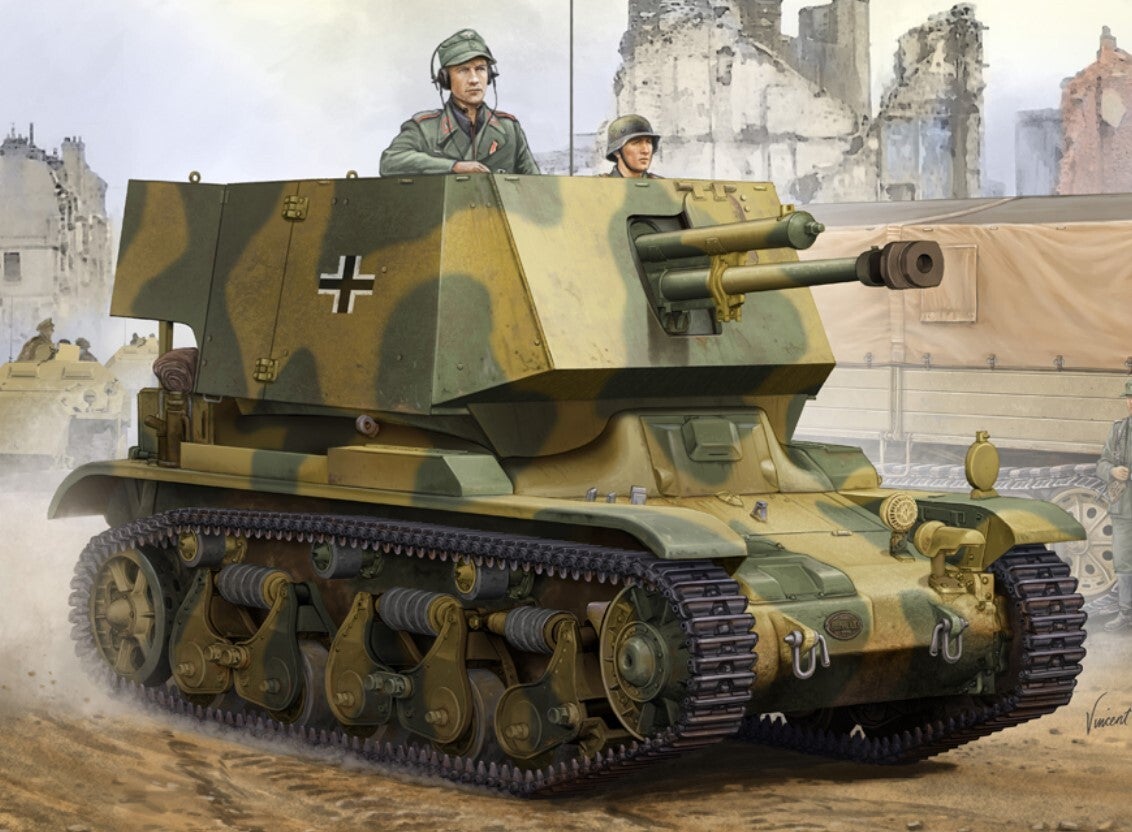
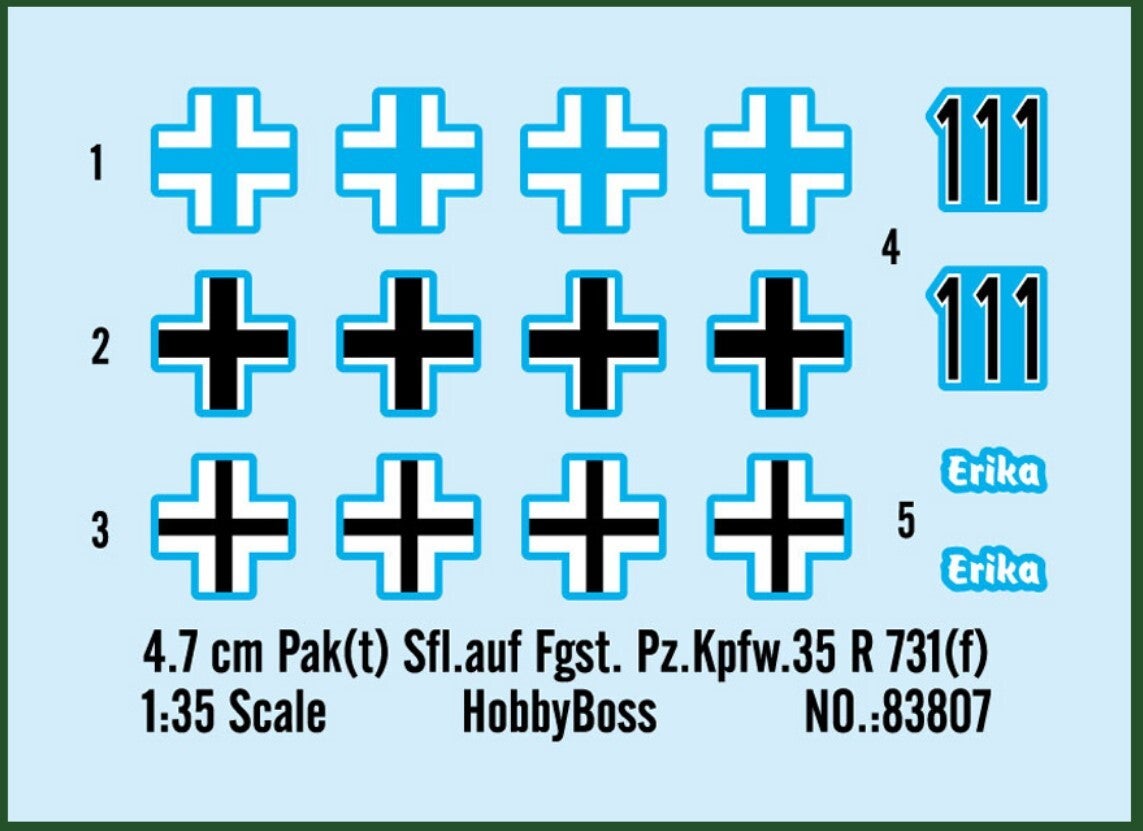
HOBBY BOSS : REF : 83807 : 1:35 : German 4.7 cm Pak(t) Sfl.auf Fgst. Pz.Kpfw.35 R 731 (f)
HOBBY BOSS REF :
83807
Manufacter :
HOBBY BOSS (CHINA).
GTIN : 6939319238078.
Scale :
1:35
---
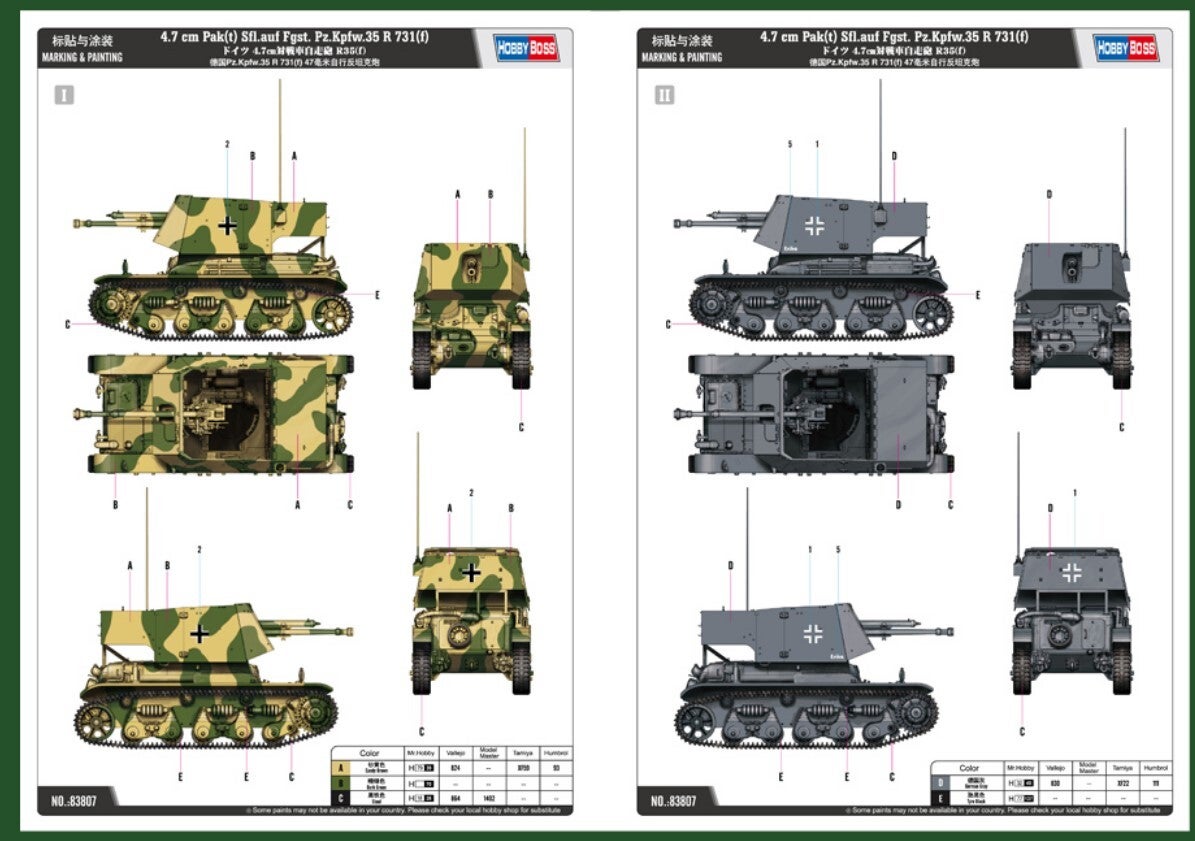
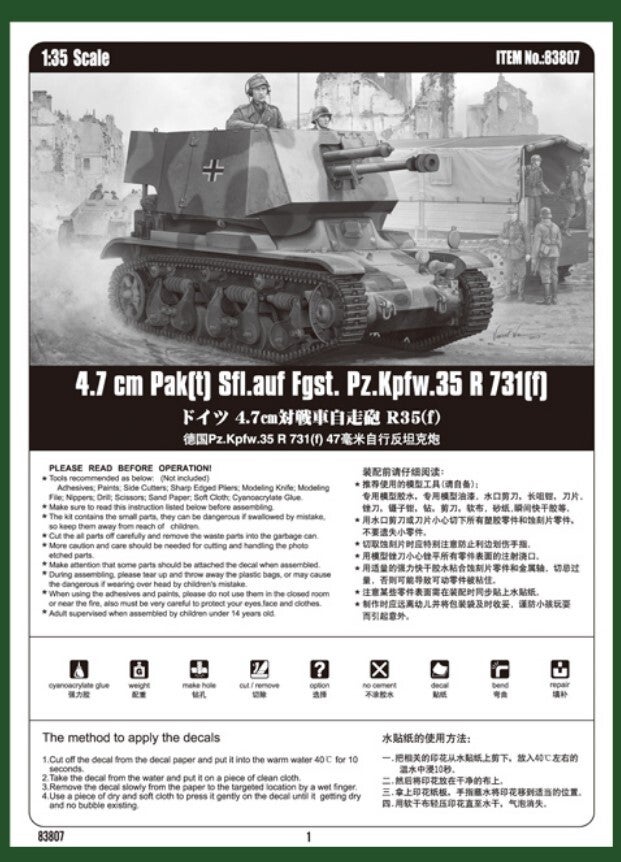
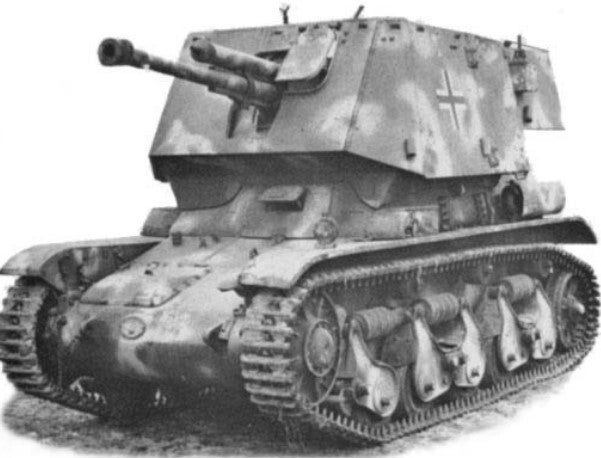
Self-Propelled Anti-Tank Gun.
It was assembled from parts of Renault R35 vehicles.
---
the kit consists of over 480 parts.
- multi-directional slide molded turret w/fine detail.
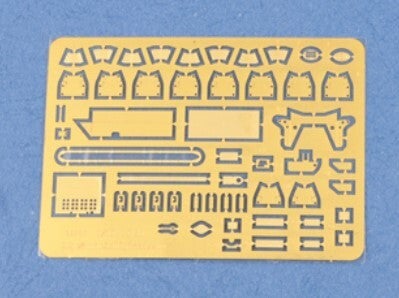
- photo-etched parts included.
---
The Renault R35, was a French light infantry tank of the Second World War.Designed from 1933 and produced from 1936, the type was intended as a light infantry support tank, equipping autonomous tank battalions, that would be allocated to individual infantry divisions to assist them in executing offensive operations. To this end it was relatively well-armoured but slow and lacking a good antitank-capacity, fitted with a short 37 mm gun. At the outbreak of the war, the antitank-rôle was more emphasized leading to the development and eventual production from April 1940 of a subtype with a more powerful longer gun, the Renault R40. It was planned to shift new production capacity to the manufacture of other, faster, types, but due to the defeat of France the R35/40 remained the most numerous French tank of the war, about 1685 vehicles having been produced in June 1940. At that moment it had also been exported to Poland, Romania, Turkey and Yugoslavia. For the remainder of the war Germany and its allies would use captured vehicles, some of them rebuilt into tank destroyers.
---
Le Renault R35 était un char d'infanterie léger français de la Seconde Guerre mondiale. Conçu à partir de 1933 et produit à partir de 1936, il était destiné à l'appui de l'infanterie légère, équipant des bataillons de chars autonomes, eux-mêmes affectés aux divisions d'infanterie pour les assister dans leurs offensives. À cette fin, il était relativement bien blindé, mais lent et peu performant en matière de lutte antichar, étant équipé d'un canon court de 37 mm. Au début du conflit, l'accent fut mis sur son rôle antichar, ce qui mena au développement et à la production, à partir d'avril 1940, d'une version améliorée dotée d'un canon plus long et plus puissant : le Renault R40. Il était prévu de réorienter les nouvelles capacités de production vers la fabrication d'autres types de chars plus rapides, mais la défaite de la France fit du R35/40 le char français le plus produit de la guerre, avec environ 1 685 exemplaires produits en juin 1940. À cette date, il avait également été exporté vers la Pologne, la Roumanie, la Turquie et la Yougoslavie. Pour le reste de la guerre, l'Allemagne et ses alliés utilisèrent des véhicules capturés, dont certains furent transformés en chasseurs de chars.
---