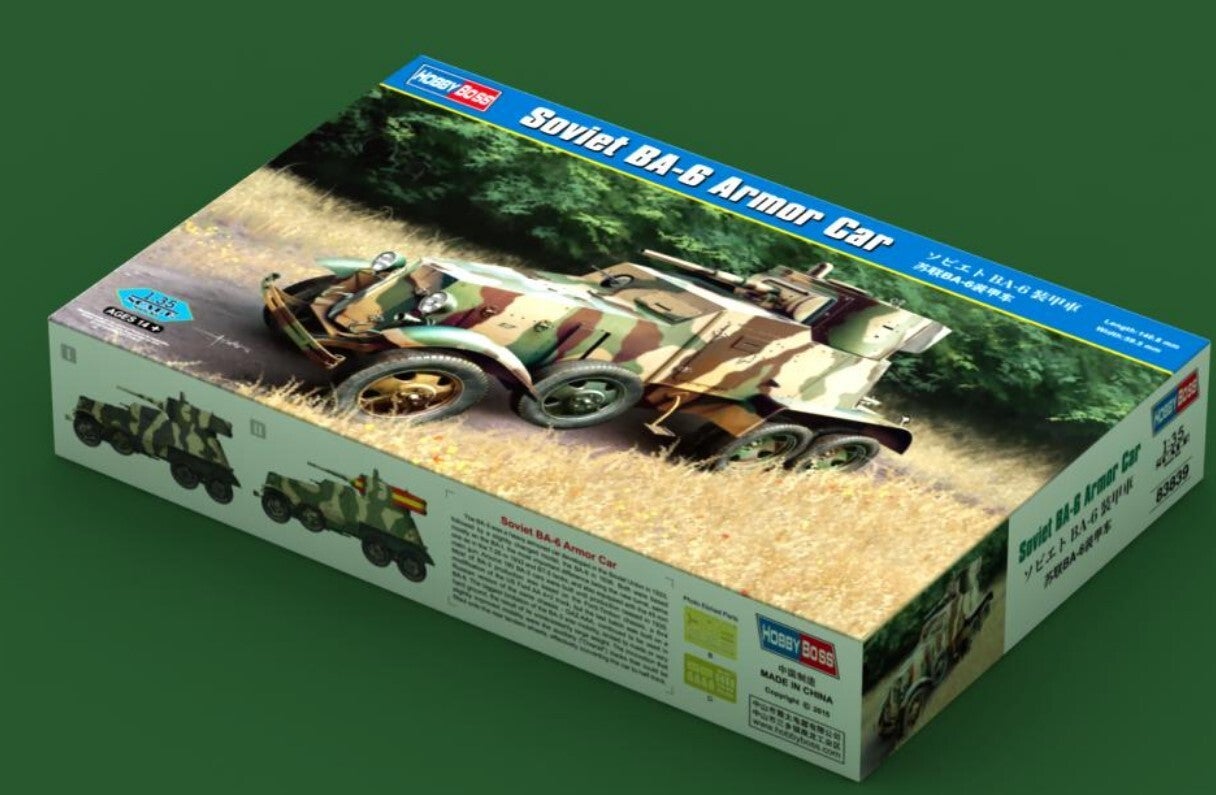
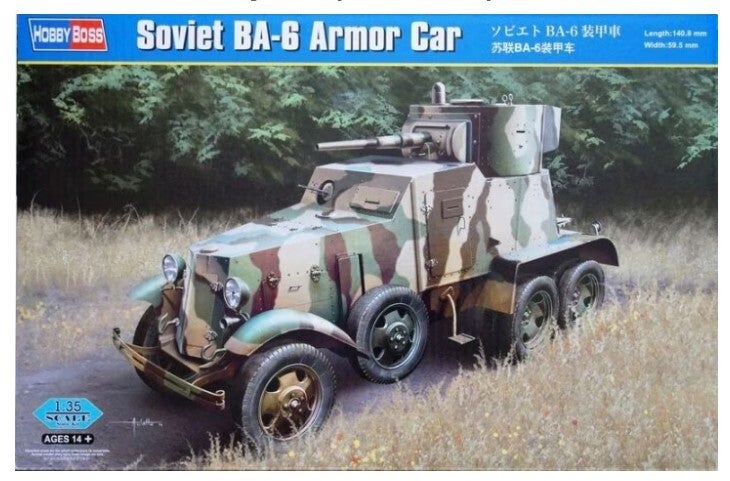
HOBBY BOSS : REF : 83839 : 1:35 : SOVIET : BA-6 Armored Car
HOBBY BOSS REF :
83839
Manufacturer :
HOBBY BOSS (CHINA).
GTIN : 6939319238399.
Scale :
1:35
---
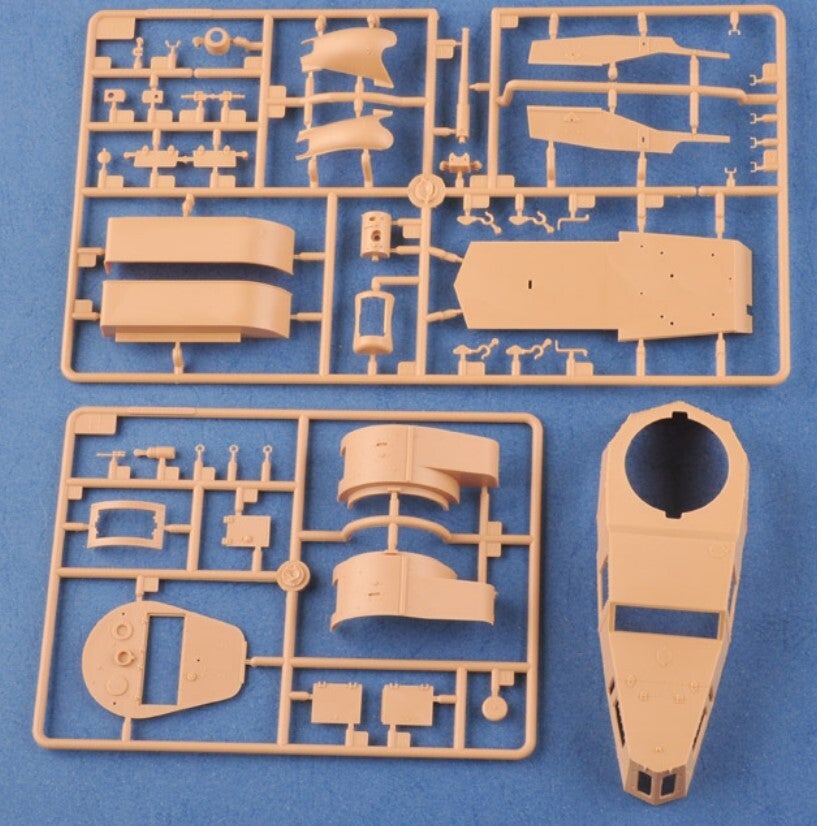
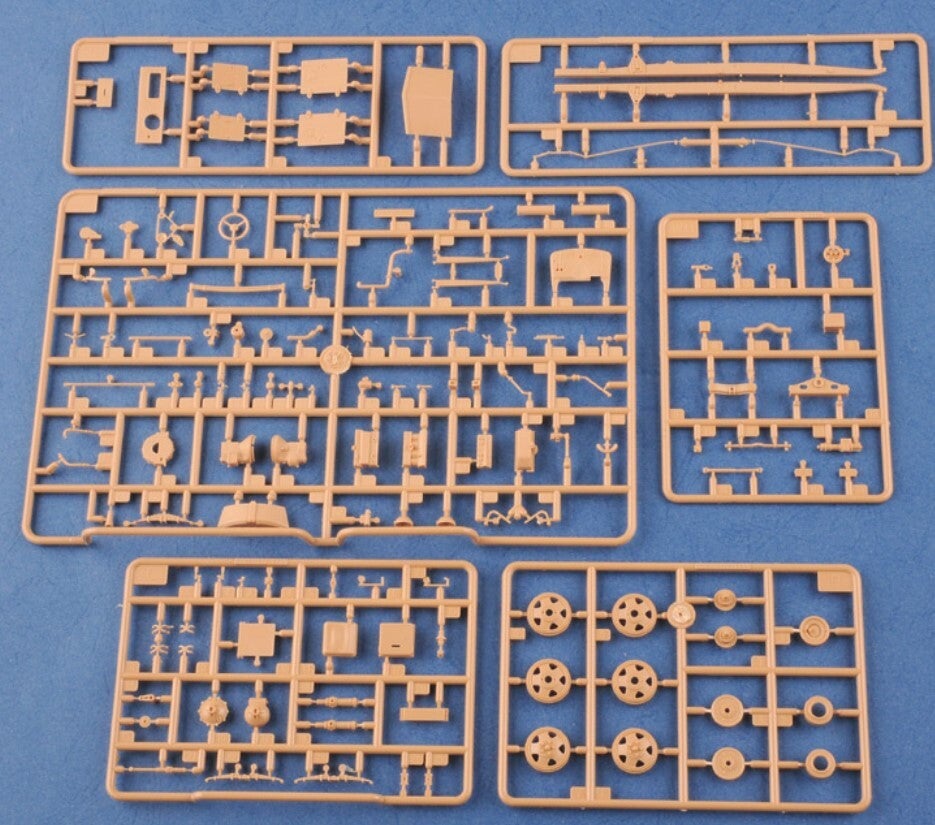
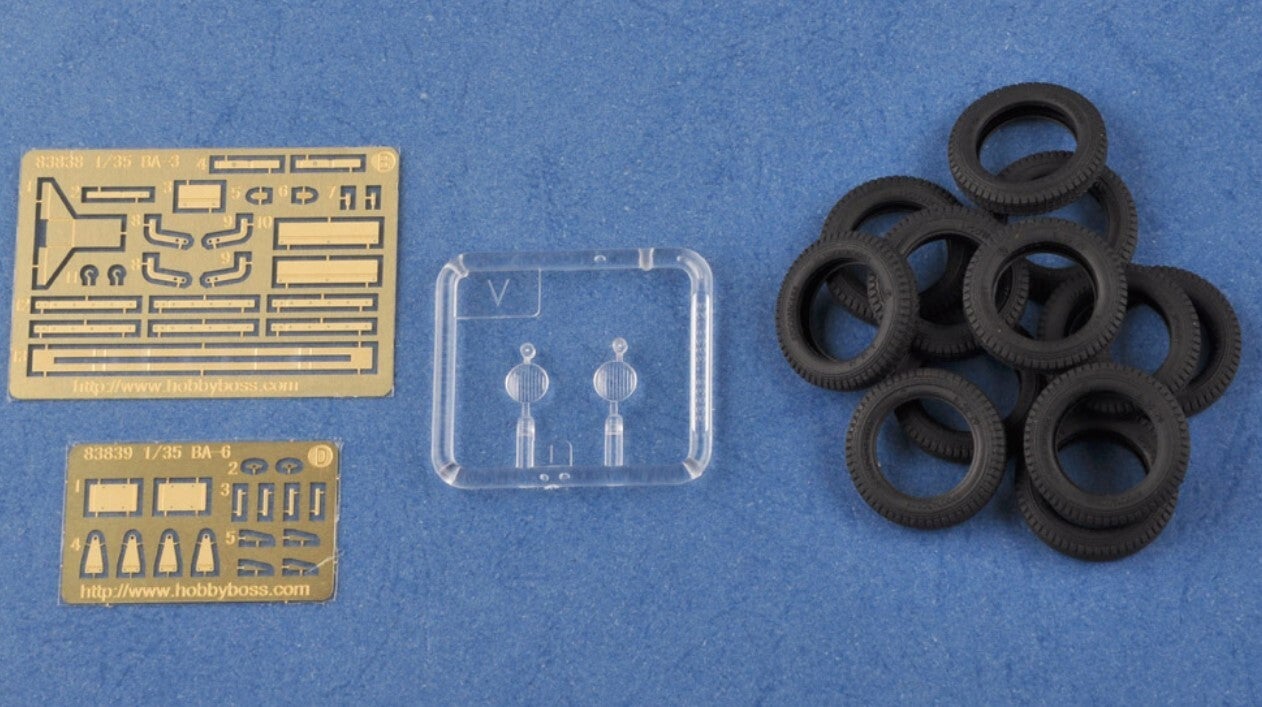
The kit consists of over 250 parts.
-the kit w/refined detail.
-multi-slide moulded hull.
-turret split into three parts.
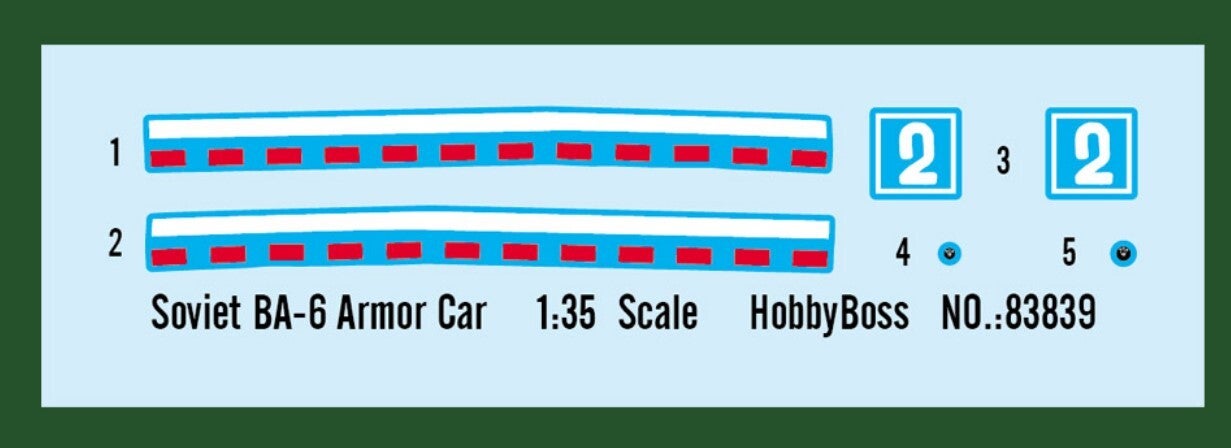
-photo etched parts included.
-rubber tires.
---
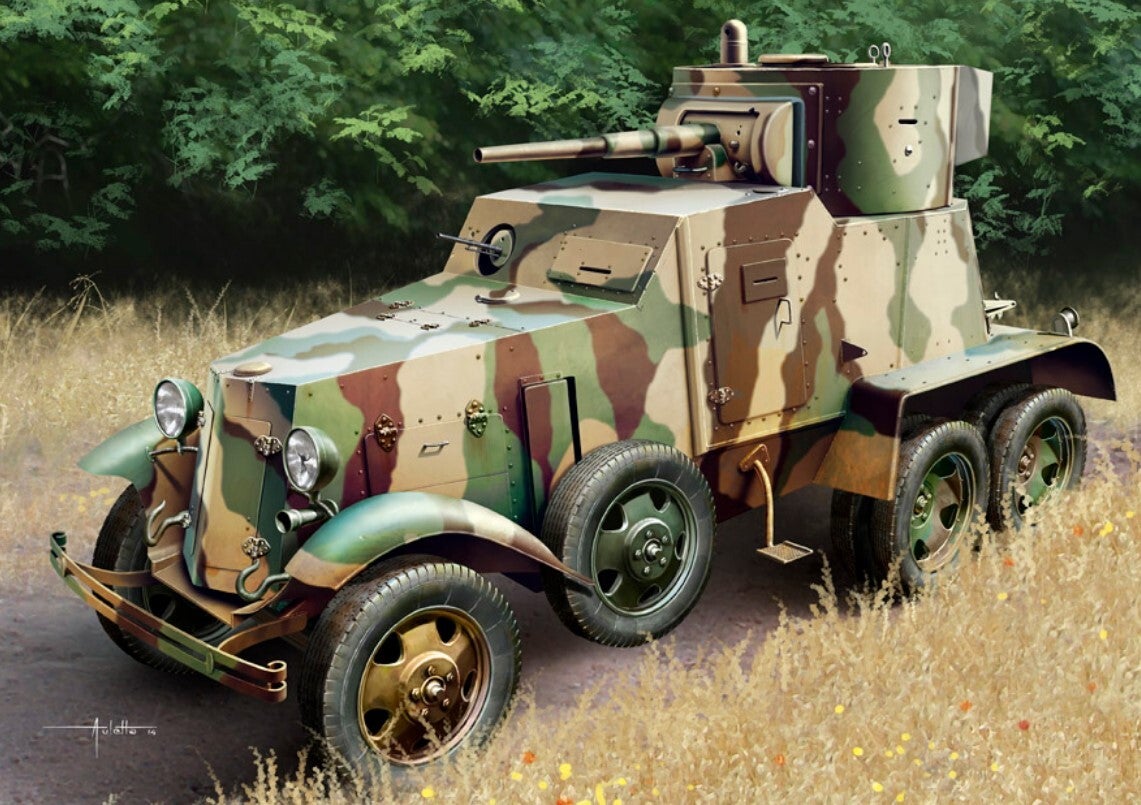
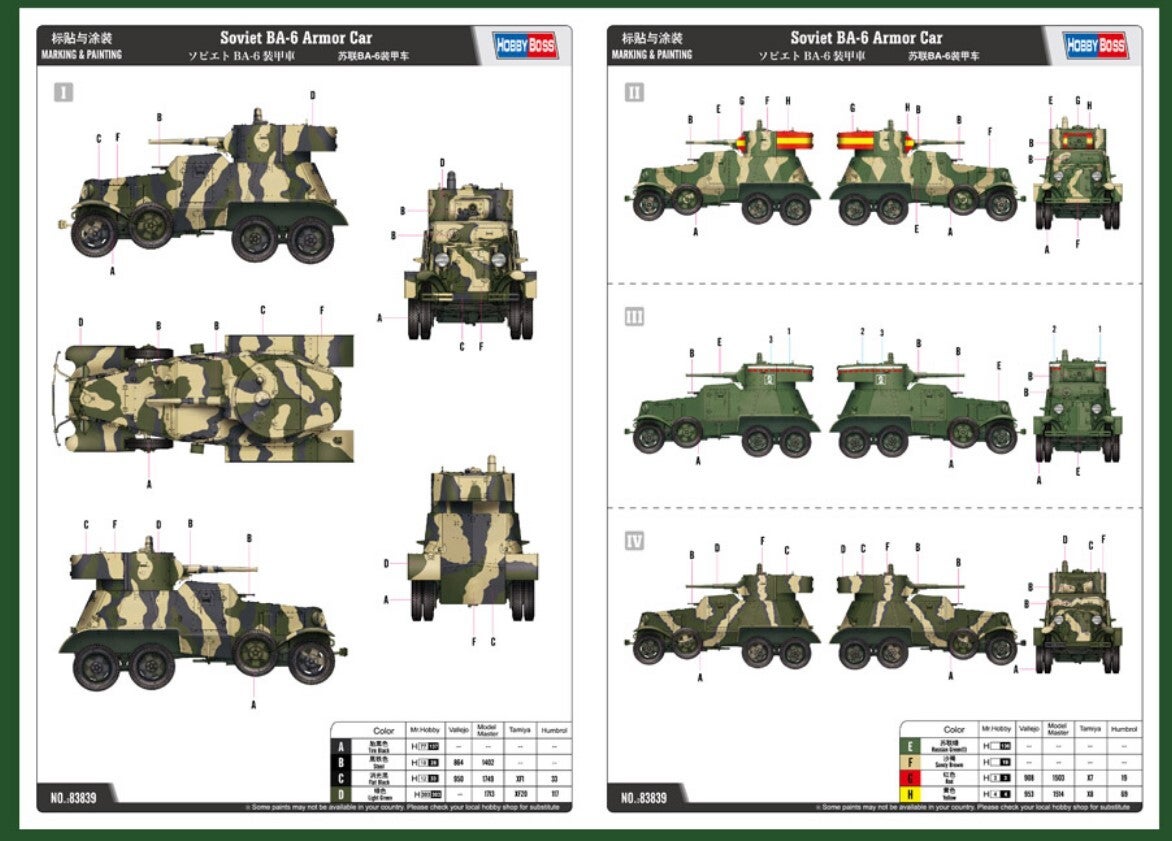
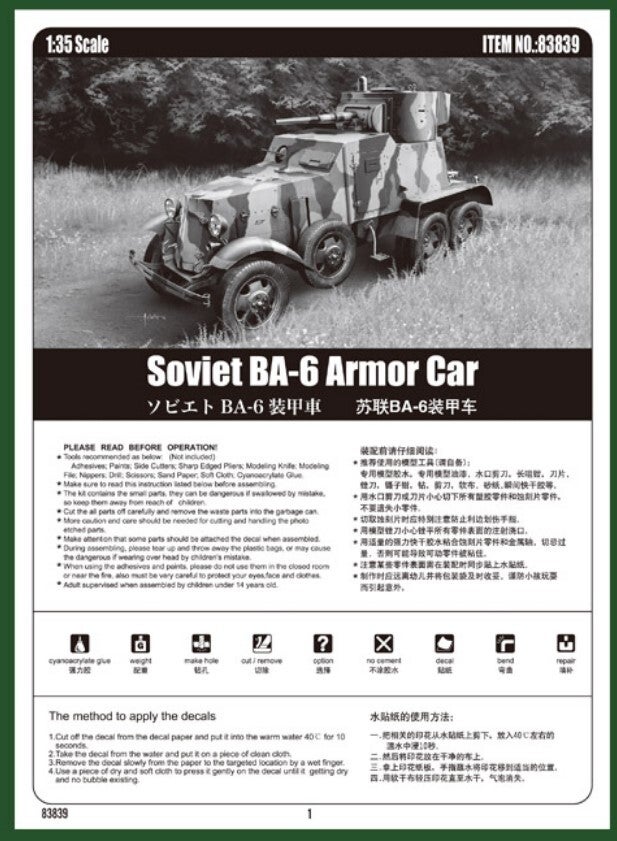
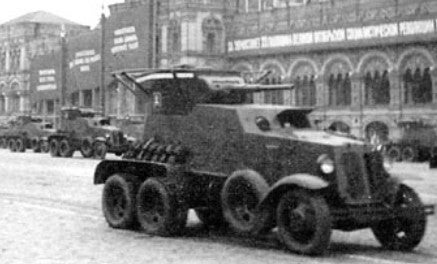
The BA-3 was a heavy armored car developed in the Soviet Union in 1933, followed by a slightly changed model, the BA-6 in1936. Both were based mostly on the BA-I, the most important difference being the new turret, same one as in the T-26 m1933 and BT-5 tanks, and also equipped with the45 mmmain gun. Around 180 BA-3 cars were built until production ceased in 1935. Most of BA-3 production was based on the Ford-Timken chassis, a 6×4 modification of the US Ford AA 4×2 truck, but the last batch was built on a Russian version of the same chassis - GAZ-AAA, continued to be used in BA-6. The biggest limitation of the BA-3 was mobility, limited to roads or very hard ground, the result of its unnecessarily large weight. The innovation that slightly improved mobility were the auxiliary ("Overall") tracks that could be fitted onto the rear tandem wheels, effectively converting the car to half-track.
---
Ce kit comprend plus de 250 pièces.
- Maquette aux détails soignés.
- Coque moulée en plusieurs parties.
- Tourelle en trois parties.
- Pièces photo-découpées incluses.
- Pneus en caoutchouc.
---
Le BA-3 était une automitrailleuse lourde développée en Union soviétique en 1933, suivie en 1936 par une version légèrement modifiée, le BA-6. Ces deux modèles étaient principalement dérivés du BA-I, la principale différence résidant dans la nouvelle tourelle, identique à celle des chars T-26 m1933 et BT-5, et également équipée d'un canon principal de 45 mm. Environ 180 BA-3 furent construits jusqu'à l'arrêt de la production en 1935. La plupart des BA-3 étaient construits sur le châssis Ford-Timken, une modification 6×4 du camion américain Ford AA 4×2, mais le dernier lot fut construit sur une version russe de ce même châssis, le GAZ-AAA, qui continua d'être utilisé sur le BA-6. Le principal défaut du BA-3 était sa mobilité, limitée aux routes ou aux terrains très durs, en raison de son poids excessif. L'innovation qui améliora légèrement sa mobilité fut l'ajout de chenilles auxiliaires (« Overall ») pouvant être fixées sur les roues tandem arrière, transformant ainsi l'automitrailleuse en semi-chenillée.
---