RYE FIELD MODEL (RFM) : REF : 5162 : 1:35 : US : M4A3 76W HVSS Sherman Late (Full Interior / CLEAR Version)
RYE FIELD MODEL REF :
5162
Manufacturer :
RYE FIELD MODEL (RFM) (CHINA).
GTIN : 6976869070017.
Scale :
1:35
---
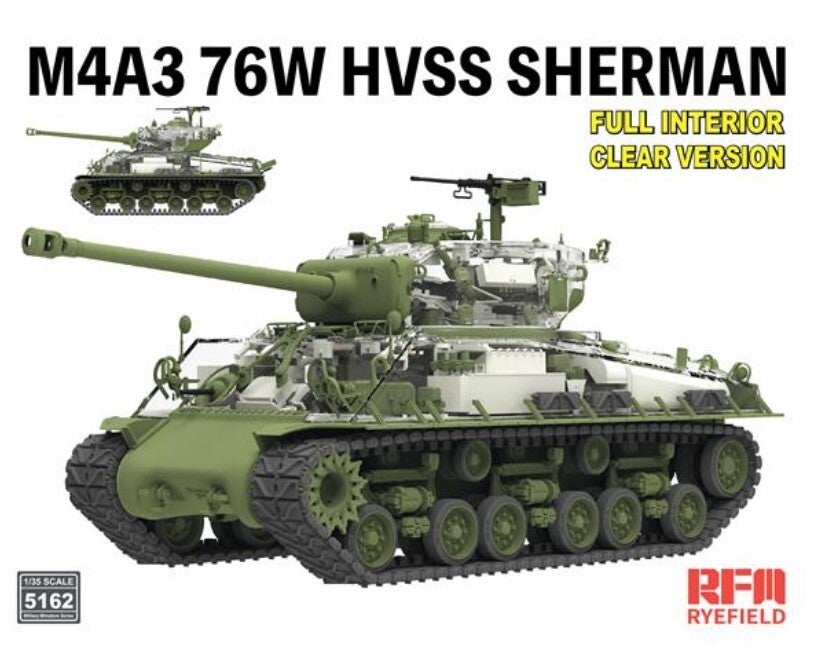
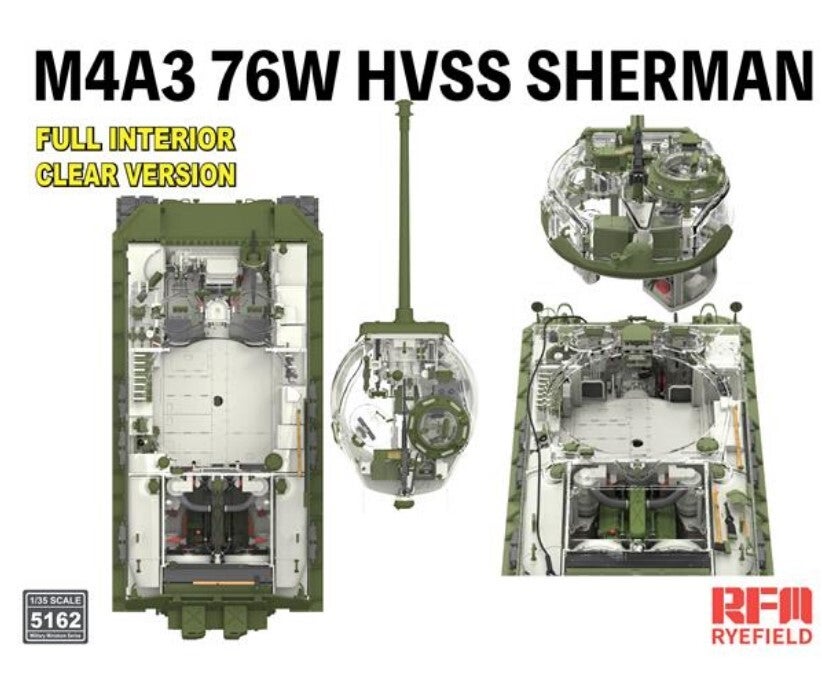
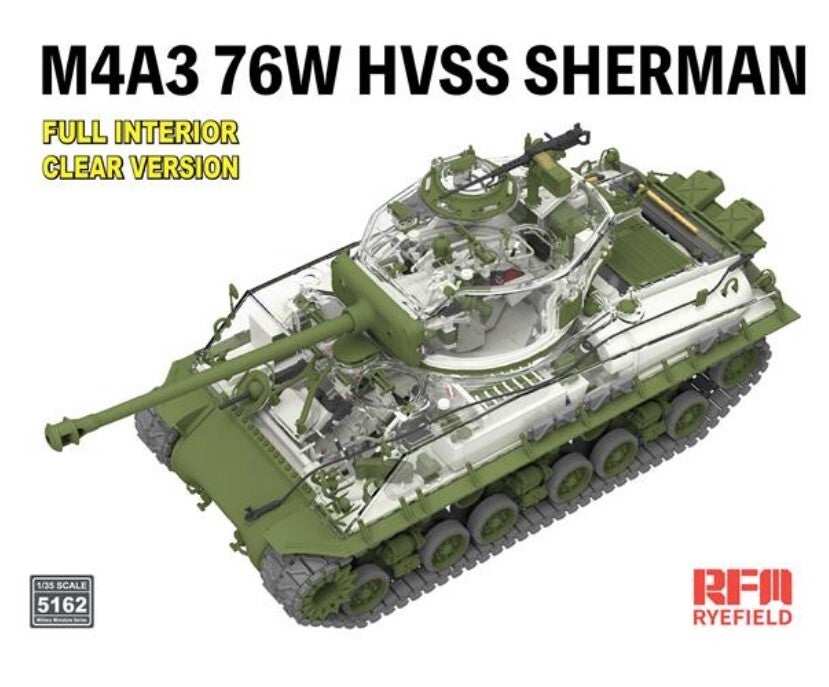
Plastic model kit for a late M4A3 76W HVSS Sherman.
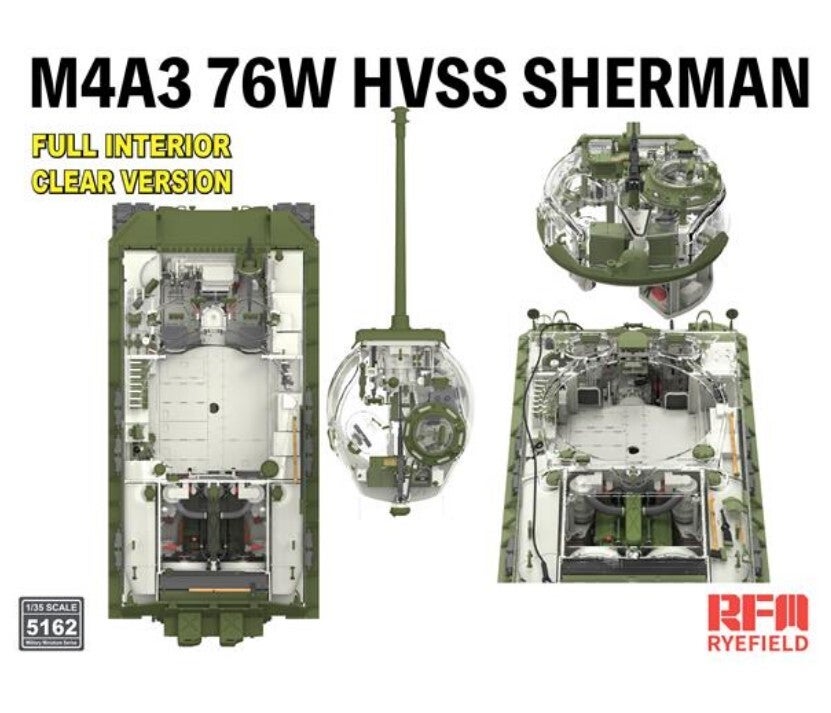
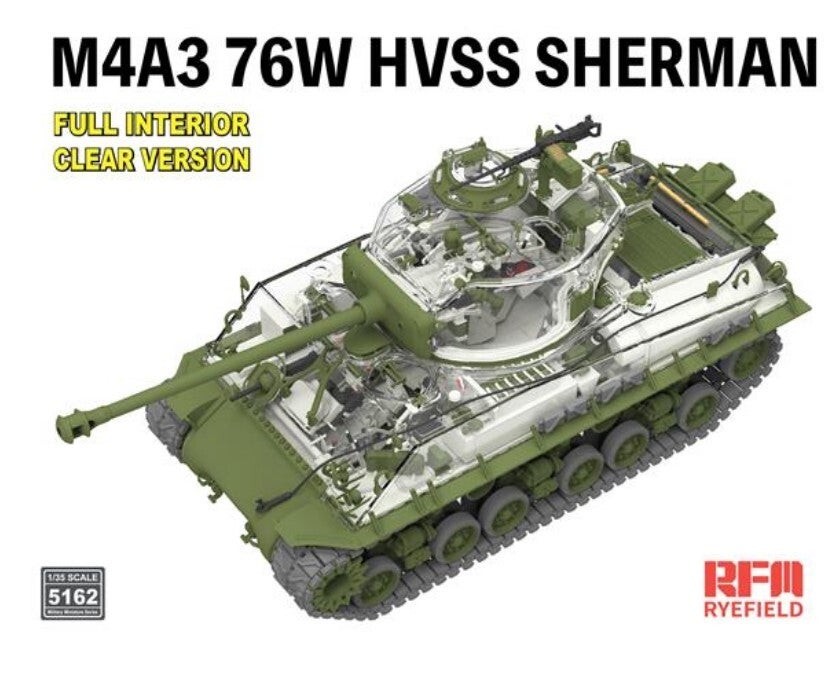
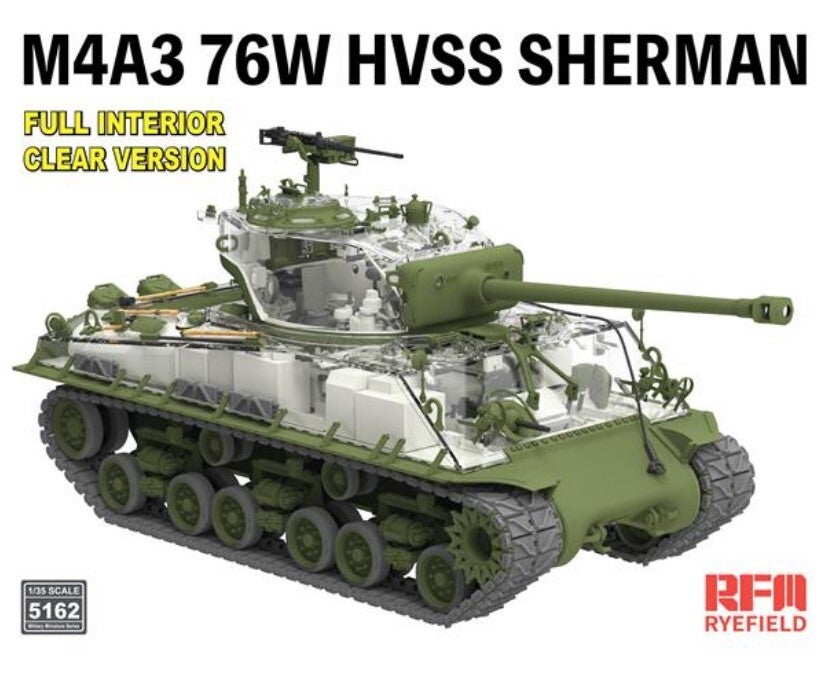
CLEAR EDITION - complete interior detail.
Scale 1:35.
Clear parts for turret and hull.
Complete interior detail (engine compartment, driver's compartment, fighting compartment, and turret).
Clear and photo-etched parts included.
Workable individual track links and running gear.
Hatches can be built open or closed.
Unbuilt, unpainted.
Paint and glue not included.
The late M4A3(76)W HVSS Sherman was considered the most powerful production version of the famous American Sherman tank of World War II. Appearing from late 1944 onward, this variant combined nearly all the major improvements of the Sherman development: the powerful Ford GAA V8 engine, the 76 mm M1A2 gun, the safe "wet stowage" ammunition storage system, and the new HVSS ("Horizontal Volute Spring Suspension") running gear. Because of its experimental designation M4A3E8, the tank earned the well-known nickname "Easy Eight."
Technically, the late HVSS Sherman differed significantly from earlier Sherman versions. The new suspension featured wider tracks and horizontally arranged leaf springs, which considerably improved ride comfort, reliability, and off-road capability. Especially in the muddy terrain of Western Europe, the tank exhibited significantly better maneuverability than older VVSS Shermans with narrower tracks. The 76 mm gun was more effective against German tanks like the Panther and Panzer IV, although it still struggled against the frontal armor of heavy German vehicles. Characteristic features of later models included the wide HVSS suspension, the T23 turret with muzzle brake, and the large driver's and radio operator's hatches of the so-called "Large Hatch" hull.
These vehicles were characterized by their ... wider tracks and horizontally arranged leaf springs, which significantly improved ride comfort, reliability, and off-road capability. The M4A3(76)W HVSS saw action in Europe and the Pacific during the final months of the war in 1944/45, proving itself particularly reliable due to its high mechanical performance and good mobility. After the war, it remained in service in large numbers and was used in the Korean War, among other campaigns. Many countries continued to use modernized "Easy Eight" Shermans well into the 1960s and, in some cases, the 1970s.
---
Maquette plastique d'un char Sherman M4A3 76W HVSS de fin de production.
ÉDITION TRANSPARENTE - intérieur détaillé.
Échelle 1:35.
Pièces transparentes pour la tourelle et la caisse.
Intérieur détaillé (compartiment moteur, poste de pilotage, compartiment de combat et tourelle).
Pièces transparentes et photodécoupées incluses.
Chenilles et train de roulement fonctionnels.
Plateaux pouvant être montés ouverts ou fermés.
Non montée, non peinte.
Peinture et colle non incluses.
Le Sherman M4A3(76)W HVSS de fin de production était considéré comme la version de série la plus puissante du célèbre char américain Sherman de la Seconde Guerre mondiale. Apparue à partir de la fin de 1944, cette variante combinait la quasi-totalité des améliorations majeures apportées au Sherman : le puissant moteur Ford GAA V8, le canon M1A2 de 76 mm, le système de stockage de munitions « humide » sécurisé et le nouveau train de roulement HVSS (« Horizontal Volute Spring Suspension »). Du fait de sa désignation expérimentale M4A3E8, le char gagna le surnom populaire de « Easy Eight ».
Techniquement, le Sherman HVSS de fin de production différait sensiblement des versions précédentes. La nouvelle suspension, avec ses chenilles plus larges et ses ressorts à lames horizontaux, améliorait considérablement le confort de conduite, la fiabilité et les capacités tout-terrain. Notamment sur les terrains boueux d’Europe occidentale, le char affichait une maniabilité nettement supérieure à celle des anciens Sherman VVSS à chenilles plus étroites. Le canon de 76 mm était plus efficace contre les chars allemands comme le Panther et le Panzer IV, même s’il restait vulnérable au blindage frontal des véhicules lourds allemands. Les modèles ultérieurs se caractérisaient notamment par une large suspension HVSS, une tourelle T23 avec frein de bouche et de larges trappes pour le conducteur et l'opérateur radio, caractéristiques de la caisse dite « Large Hatch ».
Ces véhicules se distinguaient par leurs chenilles plus larges et leurs ressorts à lames horizontaux, qui amélioraient considérablement le confort de conduite, la fiabilité et les capacités tout-terrain. Le M4A3(76)W HVSS fut engagé en Europe et dans le Pacifique durant les derniers mois de la guerre, en 1944-1945, et se révéla particulièrement fiable grâce à ses performances mécaniques élevées et à sa bonne mobilité. Après la guerre, il resta en service en grand nombre et fut notamment utilisé pendant la guerre de Corée. De nombreux pays continuèrent d'utiliser des Sherman « Easy Eight » modernisés jusque dans les années 1960, voire 1970 dans certains cas.
---