RYE FIELD MODEL (RFM) : REF : 5165 : 1:35 : German Sd.Kfz.182 ("King Tiger") Porsche Turret (FULL INTERIOR)
RYE FIELD MODEL REF :
5165
Manufacturer :
RYE FIELD MODEL (RFM) (CHINA).
GTIN : 6976869070116.
Scale :
1:35
---
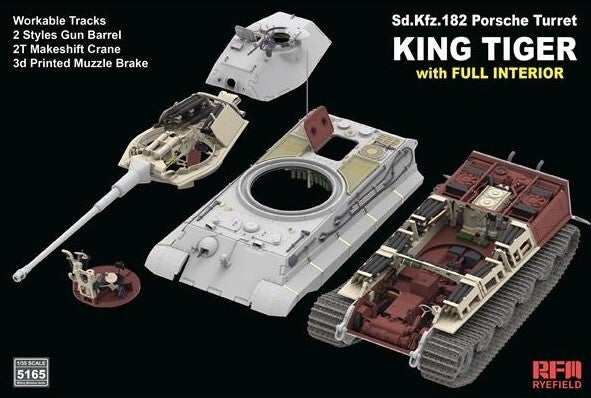
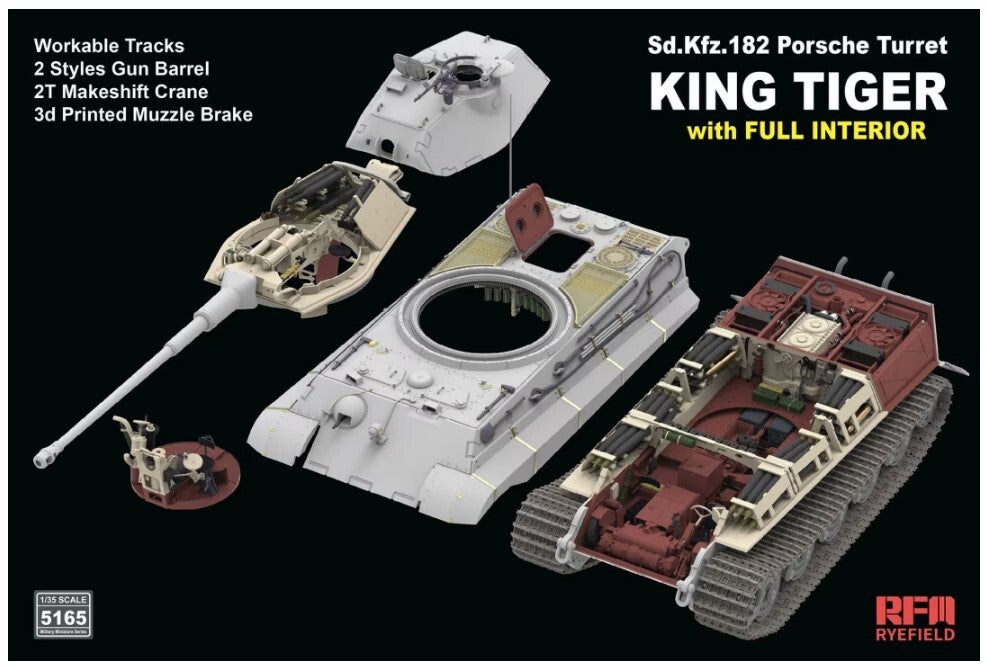
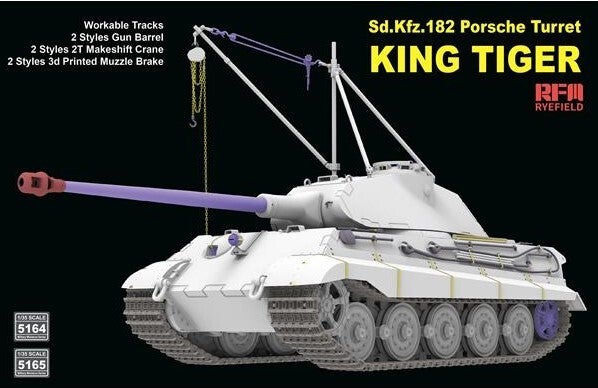
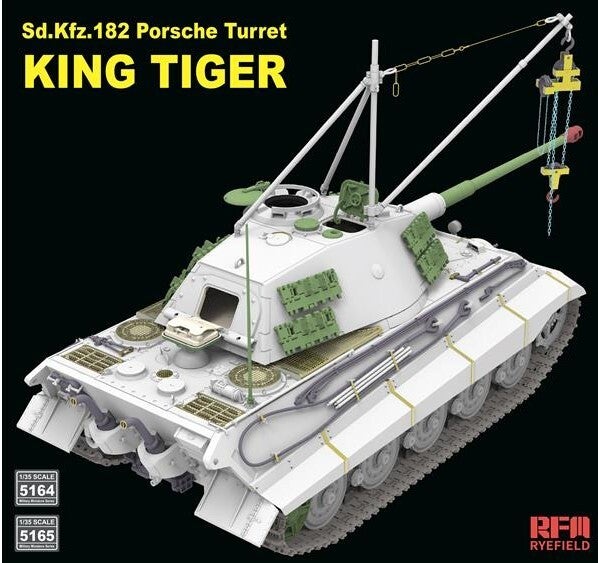
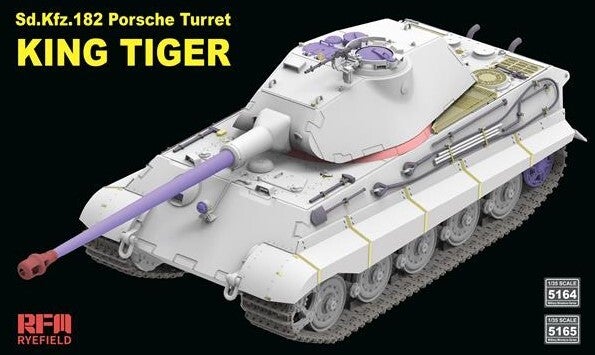
Plastic model kit for an Sd.Kfz. 182 Pz.Kpfw. VI Tiger Ausf. B "King Tiger" with Porsche turret and 2-ton field crane with complete Interior
1:35 scale.
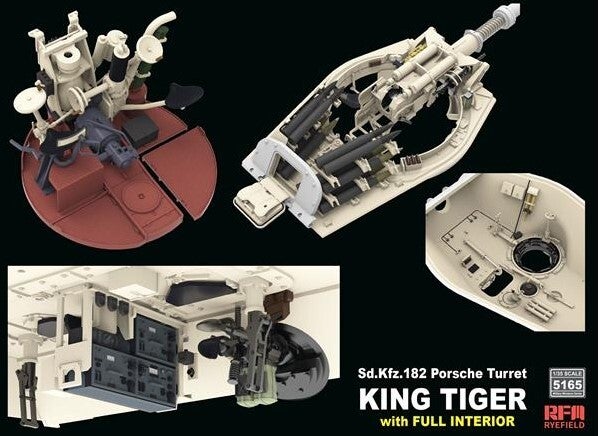
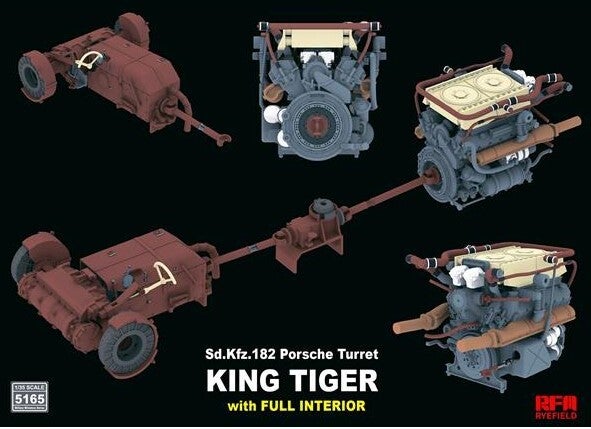
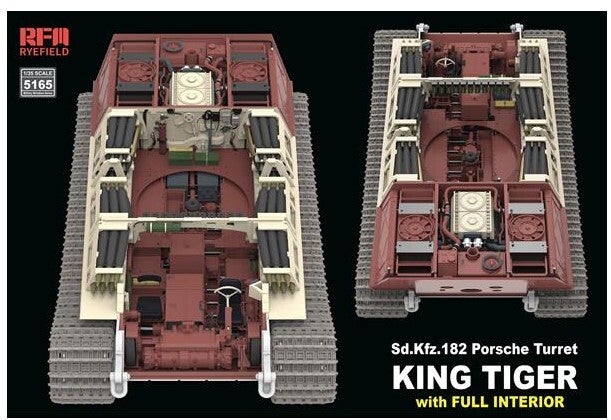
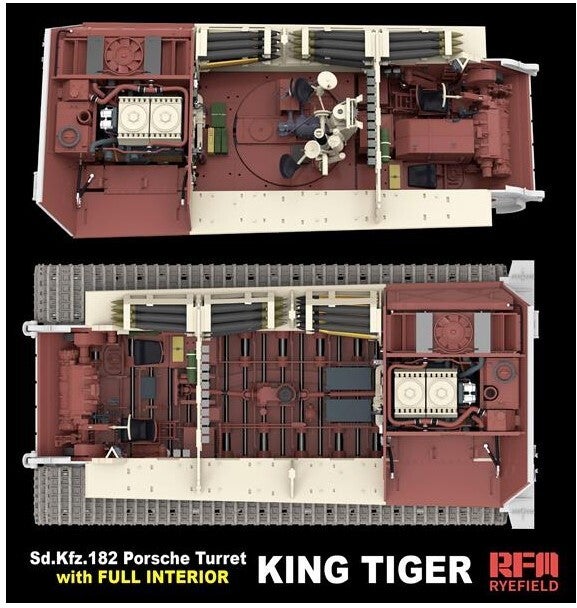
Full interior detail (driver's compartment, fighting compartment, turret, engine bay).
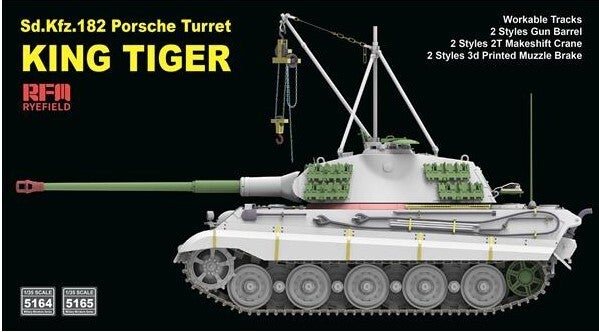
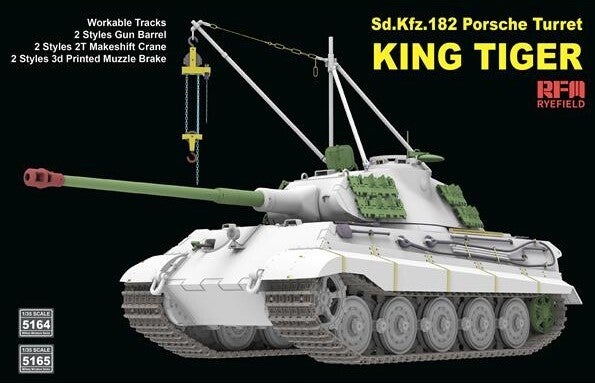
Field crane can be built in two different versions
Two different gun barrels.
Two different 3D-printed muzzle brakes.
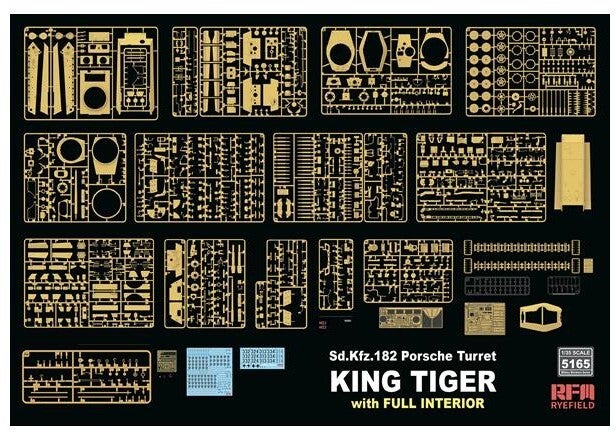
Includes clear parts, metal parts, and photo-etched parts.
Workable individual-link tracks.
Hatches can be built open or closed.
Workable gun with breech details.
Side skirts (Schürzen) as separate parts.
5 marking options.
Additional decals for ammunition and interior.
Unassembled, unpainted.
Paint and glue not included.
The Sd.Kfz. 182 Panzerkampfwagen VI Tiger Ausf. B "King Tiger" (Königstiger), featuring the so-called "Porsche turret" and a 2-ton field crane, is one of the particularly distinctive early variants of this German heavy tank. With a combat weight of around 69 tons, the King Tiger was the heaviest German mass-produced tank of World War II and was powered by a 700 hp Maybach HL 230 P30 V12 gasoline engine. Its main armament consisted of the powerful 8.8 cm KwK 43 L/71 gun, supplemented by 7.92 mm MG 34 machine guns.
The turret often referred to as the "Porsche turret" was actually designed by Krupp. The name stems from the fact that the first 50 turrets were originally intended for the VK 45.02 (P) developed by Porsche. After the Henschel chassis was selected over the Porsche design, the turrets that had already been manufactured were mounted on the first 50 Henschel King Tiger chassis. A characteristic feature is the heavily rounded turret front—approximately 100 mm thick—with its distinctive gun mantlet. The tall commander's cupola and the early arrangement of the turret hatches also distinguish these turrets from the later version.
However, the curved turret front had a ballistic disadvantage: at certain impact angles, projectiles striking the turret front or the gun mantlet could be deflected downwards, thereby endangering the significantly more thinly armored roof section of the hull. Consequently, on the later "Henschel turret"—also manufactured by Krupp—the turret front was fundamentally redesigned to have a flatter profile.
The addition of a 2-ton auxiliary crane is of particular interest regarding maintenance, repair, and overhaul operations. Such an auxiliary crane enabled the lifting of heavy components and facilitated tasks involving the engine, transmission, or running gear, for example. For a vehicle as complex and heavy (weighing around 69 tons) as the Tiger II, this type of support was of considerable practical value for field repairs. A Tiger II featuring the early Porsche turret and a 2-ton auxiliary crane is therefore particularly well-suited for depicting a maintenance or workshop vehicle in frontline service, combining the distinctive early turret design with unusual and technically interesting maintenance equipment.
---
Maquette plastique du Sd.Kfz. 182 Pz.Kpfw. VI Tiger Ausf. B « Tigre royal » avec tourelle Porsche et grue de campagne de 2 tonnes, intérieur complet.
Échelle 1:35.
Intérieur détaillé (poste de pilotage, compartiment de combat, tourelle, compartiment moteur).
Deux versions de la grue de campagne sont disponibles.
Deux canons différents.
Deux freins de bouche imprimés en 3D.
Pièces transparentes, métalliques et photodécoupées incluses.
Chenilles à maillons individuels fonctionnelles.
Plateaux ouvrants ou fermés.
Canon fonctionnel avec détails de culasse.
Jupes latérales (Schürzen) en pièces séparées.
5 options de marquage.
Décalcomanies supplémentaires pour les munitions et l'intérieur.
Non assemblée, non peinte.
Peinture et colle non incluses.
Le Sd.Kfz. Le 182e Panzerkampfwagen VI Tiger Ausf. B « King Tiger » (Königstiger), doté de la tourelle dite « Porsche » et d'une grue de campagne de 2 tonnes, est l'une des premières versions particulièrement distinctives de ce char lourd allemand. Avec un poids en ordre de combat d'environ 69 tonnes, le King Tiger était le char allemand de série le plus lourd de la Seconde Guerre mondiale et était propulsé par un moteur à essence Maybach HL 230 P30 V12 de 700 ch. Son armement principal se composait du puissant canon de 8,8 cm KwK 43 L/71, complété par des mitrailleuses MG 34 de 7,92 mm.
La tourelle souvent appelée « tourelle Porsche » a en réalité été conçue par Krupp. Ce nom provient du fait que les 50 premières tourelles étaient initialement destinées au VK 45.02 (P) développé par Porsche. Après le choix du châssis Henschel au détriment du modèle Porsche, les tourelles déjà fabriquées furent montées sur les 50 premiers châssis Henschel de King Tiger. Une caractéristique marquante est le devant de tourelle fortement arrondi (environ 100 mm d'épaisseur) avec son mantelet de canon distinctif. La haute coupole du chef de char et la disposition initiale des trappes de tourelle distinguent également ces tourelles de la version ultérieure.
Cependant, le devant de tourelle incurvé présentait un inconvénient balistique : sous certains angles d'impact, les projectiles frappant le devant de la tourelle ou le mantelet du canon pouvaient être déviés vers le bas, mettant ainsi en danger la partie supérieure de la caisse, nettement moins blindée. Par conséquent, sur la tourelle « Henschel » ultérieure, également fabriquée par Krupp, le devant de la tourelle fut fondamentalement redessiné pour présenter un profil plus plat.
L'ajout d'une grue auxiliaire de 2 tonnes est particulièrement intéressant pour les opérations de maintenance, de réparation et de révision. Une telle grue auxiliaire permettait de lever des composants lourds et facilitait les interventions sur le moteur, la transmission ou le train de roulement, par exemple. Pour un véhicule aussi complexe et lourd (environ 69 tonnes) que le Tiger II, ce type de soutien s'avérait extrêmement précieux pour les réparations sur le terrain. Un Tiger II équipé de la première tourelle Porsche et d'une grue auxiliaire de 2 tonnes est donc particulièrement adapté pour représenter un véhicule de maintenance ou d'atelier en première ligne, alliant la conception caractéristique de cette tourelle à un équipement de maintenance original et techniquement intéressant.
---