MODELSVIT (SOVA M) : REF : SVM-4801 : 1:48 : AIRCRAFT KIT : UK : DE HAVILLAND : DH.60G Coupe (Polar British Expedition ) (LIMITED EDITION) (1925-1939)
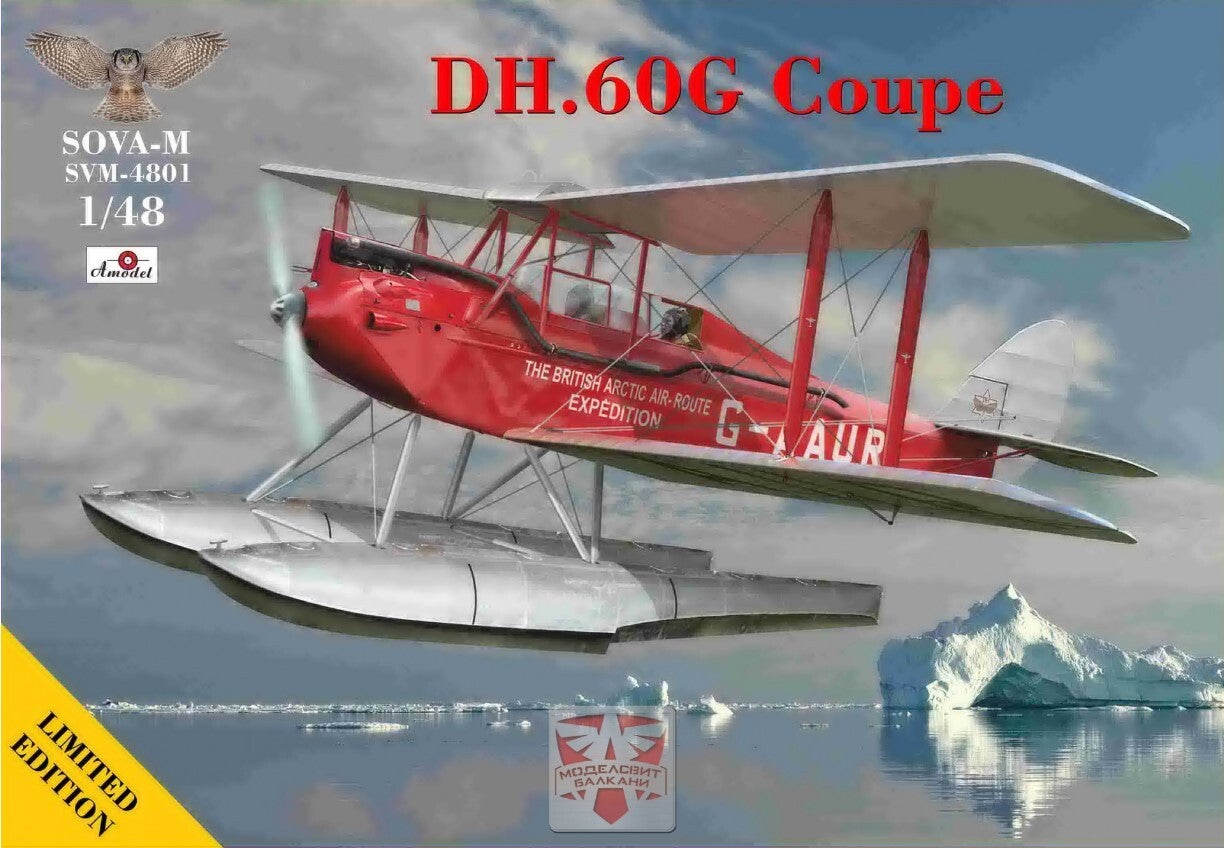
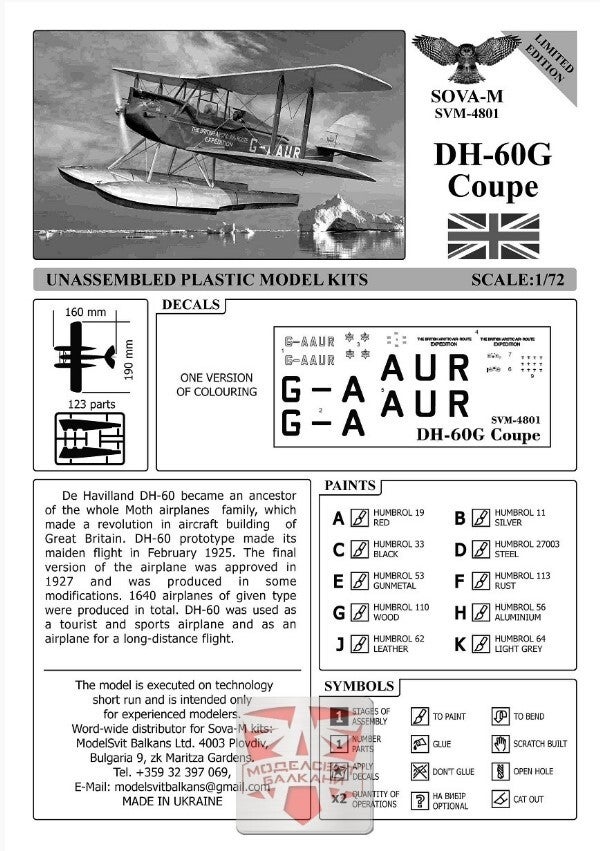
MODELSVIT BALKANS REF :
(SOVA M).
SVM-4801.
Manufacturer :
Modelsvit (Ukraine).
GTIN : 3800237894819.
Scale :
1:48
Parts : 123.
----
The de Havilland DH.60 Moth is a two-seat light biplane; 1,535 units were built between 1925 and 1939 by the British manufacturer de Havilland Aircraft Company.
Geoffrey de Havilland designed the aircraft primarily for touring and flight training. He wanted a relatively affordable machine that would allow amateur pilots to travel. The design drew heavily on experience gained from two earlier biplanes: the small de Havilland DH.53 Humming Bird (1923) and the much larger de Havilland DH.51 (1924). All these aircraft were built at the company's factory located at Stag Lane Aerodrome, near London. The Moth—named after the insect, as de Havilland was an insect collector—featured a simple design. The fuselage was constructed around four spruce longerons and covered with plywood, while the tail unit was made of wood and fabric. It featured two open cockpits in tandem and a reasonably spacious luggage compartment. The landing gear was designed to be forgiving of rough terrain and minor piloting errors; it utilized a very simple design featuring an elastomer shock absorber. For the engine, de Havilland turned to the Aircraft Disposal Company (ADC), a firm specializing in the trade and conversion of surplus World War I aviation equipment. ADC engine designer Frank Halford created a lightweight engine—the Cirrus—based on the 80-horsepower Renault V8 with which de Havilland was already familiar (it had powered the Airco DH.6). The Cirrus was an air-cooled, inline four-cylinder engine that incorporated components from the Renault V8 (specifically, a single bank of cylinders) alongside new parts.
---
Le de Havilland DH.60 Moth (papillon de nuit, en anglais) est un avion léger biplan biplace, construit à 1 535 exemplaires entre 1925 et 1939, par le constructeur aéronautique britannique de Havilland Aircraft Company.
Geoffrey de Havilland conçoit cet avion principalement comme avion de tourisme, et comme avion école. Il veut un appareil relativement abordable, permettant à des pilotes amateurs de voyager. La conception s'appuie beaucoup sur l'expérience acquise avec deux biplans précédents, le petit de Havilland DH.53 Humming Bird (en) de 1923 et le bien plus massif de Havilland DH.51 (en) de 1924. Tous ces avions sont construits dans l'usine de l'entreprise, installée sur l'aérodrome de Stag Lane près de Londres. Le Moth (en anglais mite, nommé ainsi car de Havilland est collectionneur d'insectes) est un avion de conception simple. Le fuselage est construit autour de quatre longerons en épicéa et couvert de contreplaqué. La voiture et l'empennage sont en bois toilé. Il y a deux cockpits ouverts en tandem, et un compartiment bagage assez spacieux. Le train d’atterrissage est souple, pour excuser les terrains accidentés et les petites erreurs de pilotage. Sa conception est très simple, avec un amortisseur à élastomères. Pour la motorisation, de Havilland se tourne vers l'Aircraft Disposal Company (ADC), une société spécialisée dans le négoce et la conversion de surplus aéronautiques de la première guerre mondiale. Le motoriste d'ADC, Frank Halford, conçoit un moteur léger, le Cirrus, à partir du V8 Renault de 80 chevaux (en) avec lequel de Havilland était déjà familier (il équipait le Airco DH.6). Le Cirrus est un quatre cylindres en ligne, refroidi par air, qui utilise des éléments du V8 Renault (une seule rangée de cylindres) et de nouvelles pièces.
---
Sources : Wikipedia.