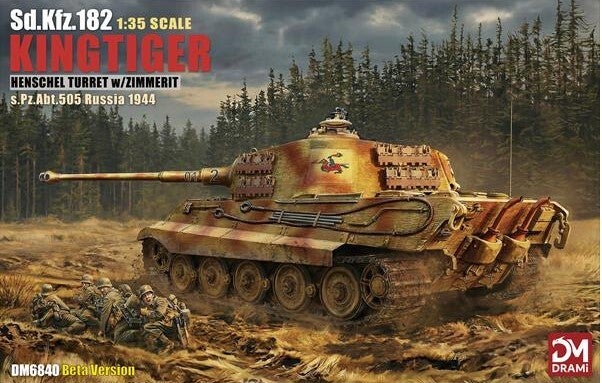
DRAMi : REF : 6840 : 1:35 : German : Sd.Kfz. 182 ("Kingtiger") Henschel Turret with Zimmerit s.Pz.Abt.505 (Russia 1944)
DRAMi (PREVIOUSLY DRAGON) :
6840
Manufacturer :
DRAMi.
EAN : 0089195868404.
Scale :
1:35
---
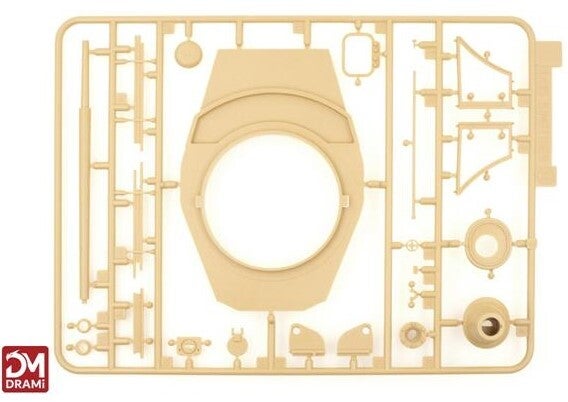
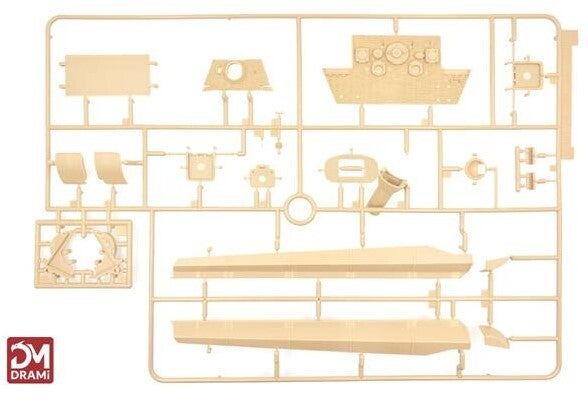
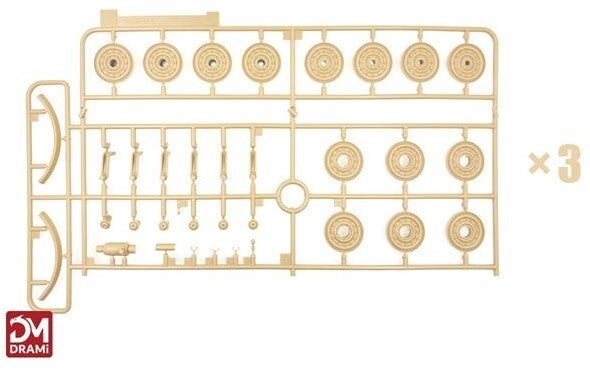
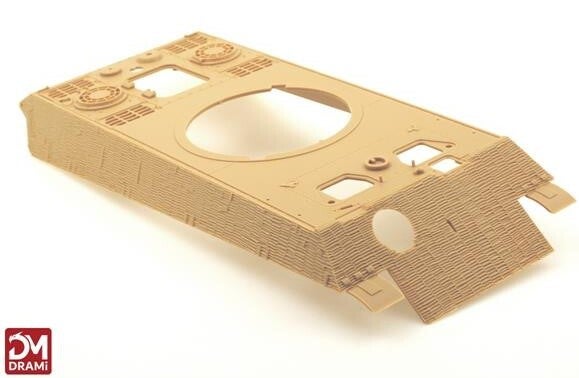
Plastic model kit for building an Sd.Kfz. 182 Tiger II with Zimmerit.
Scale 1:35.
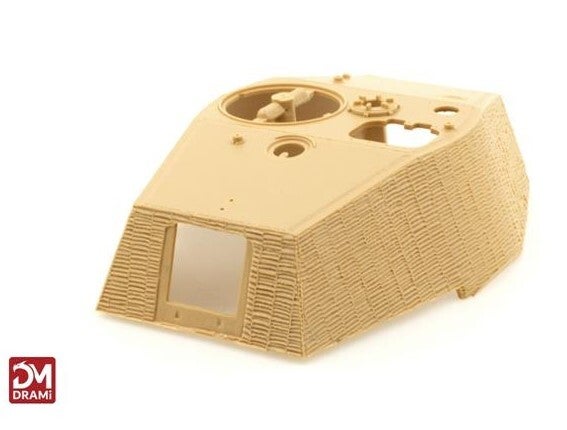
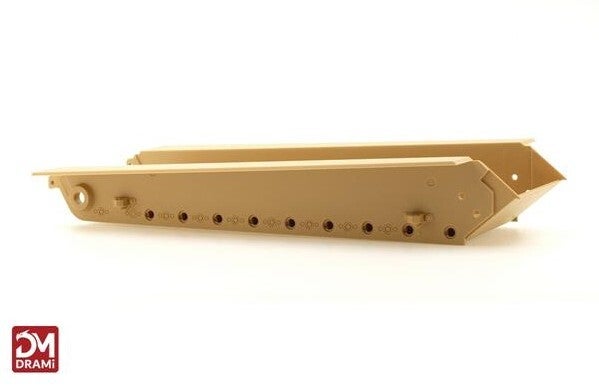
Hull and turret feature molded-on Zimmerit.
2 upper turret parts.
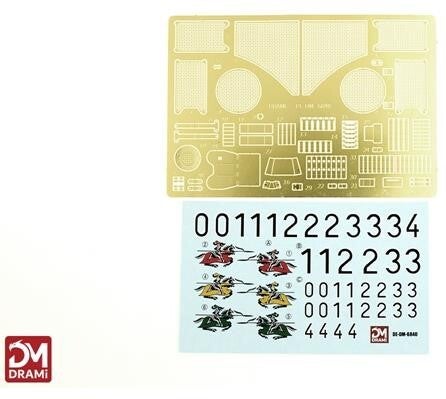
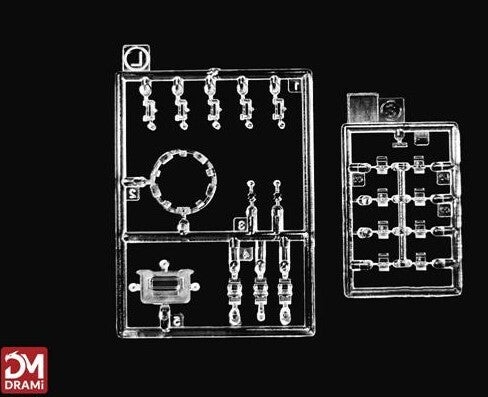
Includes clear parts and photo-etched parts.
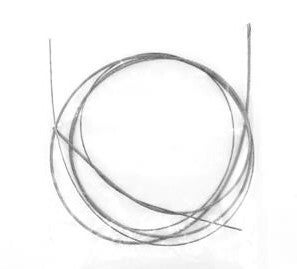
Wire cable.
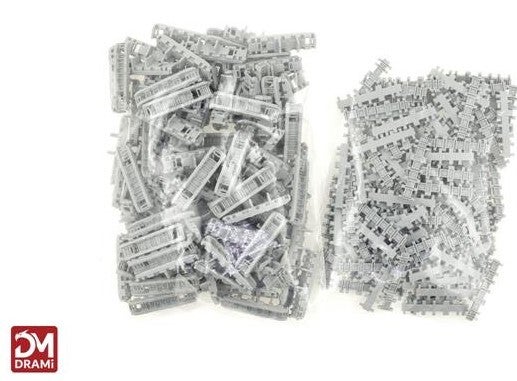
Individual-link tracks.
3 marking options.
Unassembled, unpainted.
Paint and glue not included.
The Sd.Kfz. 182 Tiger II - officially designated Panzerkampfwagen Tiger Ausf. B and commonly known as the "King Tiger" (Königstiger) - was a German heavy tank from the Second World War. It combined a powerful 8.8 cm gun with heavy, sloped armor. However, its significant weight, technical issues, and high logistical requirements limited its overall military utility.
Development began in 1942. Henschel and Porsche worked on competing chassis designs; the Henschel design was ultimately selected for production. Krupp developed the turrets. Consequently, the Tiger II was a largely new design, differing significantly from the Tiger I.
On-road top speeds were reported to be around 35–40 km/h, while off-road speeds of approximately 15 km/h were more realistic. Data based on the contemporary driver’s manual indicates an operational range of about 140 km on roads and 90 km cross-country. Such figures were highly dependent on terrain, driving style, and the condition of the vehicle.
The KwK 43 L/71 was an exceptionally powerful tank gun for its time; the "L/71" designation indicates a barrel length of approximately 71 calibers. It allowed the tank to engage many enemy armored vehicles at long range. Simultaneously, its heavy frontal armor provided substantial protection. This did not, however, render the tank invulnerable; factors such as the point of impact, engagement distance, type of ammunition, and the specific combat situation remained critical. The common terms "Porsche turret" and "Henschel turret" are misleading, as both turret designs originated from Krupp:
The early turret featured a rounded front and a distinct bulge around the commander’s cupola.
The later production turret had a more heavily armored, largely flat front and a simplified design.
The association with Porsche stems from the development history of the early turret, which was intended for a vehicle design that was ultimately rejected.
Serial production took place primarily between January 1944 and March 1945 at the Henschel plant in Kassel. The first combat deployments occurred in Normandy in July 1944.
---
Maquette en plastique à assembler d'un Sd.Kfz. 182 Tiger II avec revêtement Zimmerit.
Échelle 1/35.
La caisse et la tourelle présentent un revêtement Zimmerit moulé.
Comprend 2 éléments pour la partie supérieure de la tourelle.
Inclut des pièces transparentes et des éléments en photodécoupe.
Câble en fil métallique.
Chenilles à maillons individuels.
3 options de marquage.
À assembler et à peindre.
Peinture et colle non incluses.
Le Sd.Kfz. 182 Tiger II — officiellement désigné *Panzerkampfwagen Tiger Ausf. B* et communément appelé « Tigre royal » (*Königstiger*) — était un char lourd allemand de la Seconde Guerre mondiale. Il combinait un puissant canon de 8,8 cm avec un blindage lourd et incliné. Cependant, son poids important, ses problèmes techniques et ses exigences logistiques élevées ont limité son utilité militaire globale.
Son développement a débuté en 1942. Henschel et Porsche ont travaillé sur des conceptions de châssis concurrentes ; c'est finalement le modèle de Henschel qui a été retenu pour la production. Krupp a développé les tourelles. Par conséquent, le Tiger II constituait une conception largement nouvelle, différant considérablement du Tiger I.
La vitesse maximale sur route était estimée à environ 35–40 km/h, tandis qu'en tout-terrain, une vitesse d'environ 15 km/h était plus réaliste. Les données issues du manuel du conducteur de l'époque indiquent une autonomie opérationnelle d'environ 140 km sur route et 90 km en tout-terrain. Ces chiffres dépendaient fortement du type de terrain, du style de conduite et de l'état du véhicule.
Le KwK 43 L/71 était un canon de char exceptionnellement puissant pour son époque ; la désignation « L/71 » indique une longueur de tube d'environ 71 calibres. Il permettait au char d'engager de nombreux véhicules blindés ennemis à longue distance. Parallèlement, son blindage frontal épais offrait une protection substantielle. Cela ne rendait pas pour autant le char invulnérable ; des facteurs tels que le point d'impact, la distance d'engagement, le type de munitions et la situation de combat spécifique restaient déterminants. Les appellations courantes « tourelle Porsche » et « tourelle Henschel » sont trompeuses, car les deux modèles de tourelles proviennent en réalité de chez Krupp :
La première version se caractérise par une façade arrondie et une protubérance marquée autour du tourelleau du chef de char.
La version produite ultérieurement présente une façade plus fortement blindée et essentiellement plane, ainsi qu’une conception simplifiée.
L’association avec Porsche découle de l’historique de développement de la première version, initialement prévue pour un projet de véhicule qui fut finalement rejeté.
La production en série s’est déroulée principalement entre janvier 1944 et mars 1945, dans l’usine Henschel de Kassel. Les premiers engagements au combat ont eu lieu en Normandie, en juillet 1944.
---