DRAMi : REF : 6258 : 1:35 : German : Panzerjäger I 4.7 cm PaK(t) (EARLY PRODUCTION)

DRAMi (PREVIOUSLY DRAGON) :
6258
Manufacturer :
DRAMi.
GTIN : 6978736091156.
Scale :
1:35
---
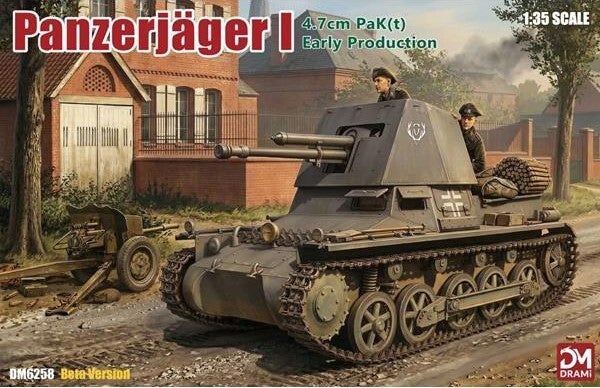
Plastic model kit for building a Panzerjäger I, 4.7 cm PaK(t) (early production).
Scale 1:35.
Fully detailed interior, including the driver's station.
Individual-link tracks.
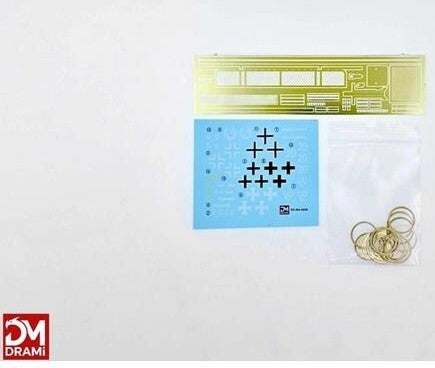
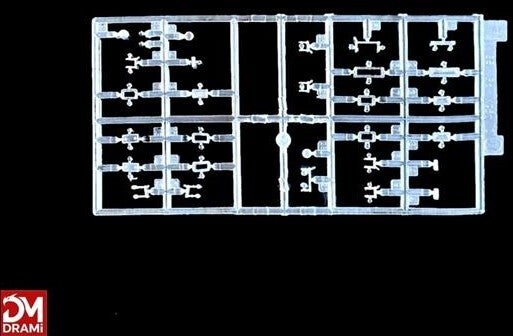
Includes clear parts and photo-etched parts.
Unbuilt, unpainted.
Paint and glue not included.
The Panzerjäger I with 4.7 cm PaK(t) (early production) was a German self-propelled anti-tank gun built on the chassis of the Panzerkampfwagen I Ausf. B. Its most distinctive feature is the five-piece armored shield surrounding the gun, which is open at the top and rear. It combined an already obsolete tank chassis with an anti-tank gun that was relatively powerful for 1940.
A total of 202 vehicles were produced between March 1940 and February 1941. The first series was manufactured in 1940.
During the conversion, the rotating machine-gun turret of the Panzer I was removed. The 4.7 cm gun was mounted on a fixed platform above the former fighting compartment; an angled armored shield protected the gun crew from the front and sides. The engine and the basic running gear layout of the Panzer I Ausf. B were retained.
The gun was supplied by Škoda in Czechoslovakia. It offered significantly better anti-tank performance than the original machine-gun armament of the Panzer I. However, the limited traverse meant that the driver had to turn the entire vehicle to engage targets outside the gun's narrow firing arc.
The Panzerjäger I was developed out of a need to provide greater mobility for anti-tank units while repurposing existing Panzer I chassis - which were already considered inadequate as main battle tanks due to their weak armament and thin armor. The German 5 cm PaK (anti-tank gun) initially considered was not yet available in the necessary quantities; the Czech 4.7 cm weapon offered a solution that could be implemented on short notice.
Deployment:
Western Campaign, 1940: First combat use during the German offensive against France and the Benelux countries.
North Africa, from 1941: Used by units including *Panzerjäger-Abteilung* 605. The open-topped design and light chassis imposed limitations on the vehicle under the conditions found there.
Eastern Front, from 1941: Continued use during the invasion of the Soviet Union. Its effectiveness diminished against more heavily armored opponents, while both the crew and the vehicle remained extremely vulnerable.
By 1942/43: Increasingly replaced by more capable anti-tank vehicles.
---
Maquette en plastique à assembler d'un Panzerjäger I, équipé d'un canon 4,7 cm PaK(t) (version de début de production).
Échelle 1/35.
Intérieur entièrement détaillé, incluant le poste de pilotage.
Chenilles constituées de maillons individuels.
Comprend des pièces transparentes et des éléments en photodécoupe.
À monter et à peindre.
Peinture et colle non incluses.
Le Panzerjäger I armé d'un canon 4,7 cm PaK(t) (version de début de production) était un chasseur de chars automoteur allemand, construit sur le châssis du Panzerkampfwagen I Ausf. B. Sa caractéristique la plus marquante est son bouclier blindé, composé de cinq éléments, qui entoure la pièce d'artillerie tout en restant ouvert sur le dessus et à l'arrière. Il associait un châssis de char déjà obsolète à un canon antichar relativement puissant pour l'époque (1940).
Au total, 202 exemplaires ont été produits entre mars 1940 et février 1941. La première série a été fabriquée en 1940.
Lors de la conversion, la tourelle rotative équipée de mitrailleuses du Panzer I a été retirée. Le canon de 4,7 cm a été installé sur une plateforme fixe, au-dessus de l'ancien compartiment de combat ; un bouclier blindé incliné protégeait les servants du canon, tant à l'avant que sur les côtés. Le moteur ainsi que la configuration générale du train de roulement du Panzer I Ausf. B ont été conservés.
Le canon était fourni par l'entreprise Škoda, en Tchécoslovaquie. Il offrait des performances antichars nettement supérieures à l'armement initial du Panzer I, qui se limitait à des mitrailleuses. Cependant, le débattement limité du canon obligeait le conducteur à faire pivoter l'ensemble du véhicule pour engager des cibles situées en dehors de l'étroit secteur de tir.
Le Panzerjäger I a été conçu pour répondre au besoin d'une meilleure mobilité des unités antichars, tout en réutilisant des châssis de Panzer I existants — des châssis alors jugés inadaptés au rôle de char de combat principal en raison de leur faible armement et de leur blindage mince. Le canon antichar allemand de 5 cm (PaK), initialement envisagé, n'était pas encore disponible en quantité suffisante ; l'arme tchèque de 4,7 cm a donc constitué une solution pouvant être mise en œuvre rapidement. Déploiement :
Campagne de l'Ouest, 1940 : Première utilisation au combat lors de l'offensive allemande contre la France et les pays du Benelux.
Afrique du Nord, à partir de 1941 : Utilisé par diverses unités, dont la *Panzerjäger-Abteilung* 605. Sa conception à ciel ouvert et son châssis léger imposaient des limites au véhicule dans les conditions rencontrées sur ce théâtre d'opérations.
Front de l'Est, à partir de 1941 : Utilisation prolongée durant l'invasion de l'Union soviétique. Son efficacité s'est amoindrie face à des adversaires mieux blindés, tandis que l'équipage comme le véhicule demeuraient extrêmement vulnérables.
Vers 1942-1943 : Remplacé progressivement par des véhicules antichars plus performants.
---