DRAMi : REF : 3207 : 1:32 : AIRCRAFT KIT : German : MESSERSCHMITT : Bf 110D-1/R1 (Long Range Heavy Fighter) (BETA VERSION)
DRAMi (PREVIOUSLY DRAGON) :
3207
Manufacturer :
DRAMi.
GTIN : pending.
Scale :
1:32
---
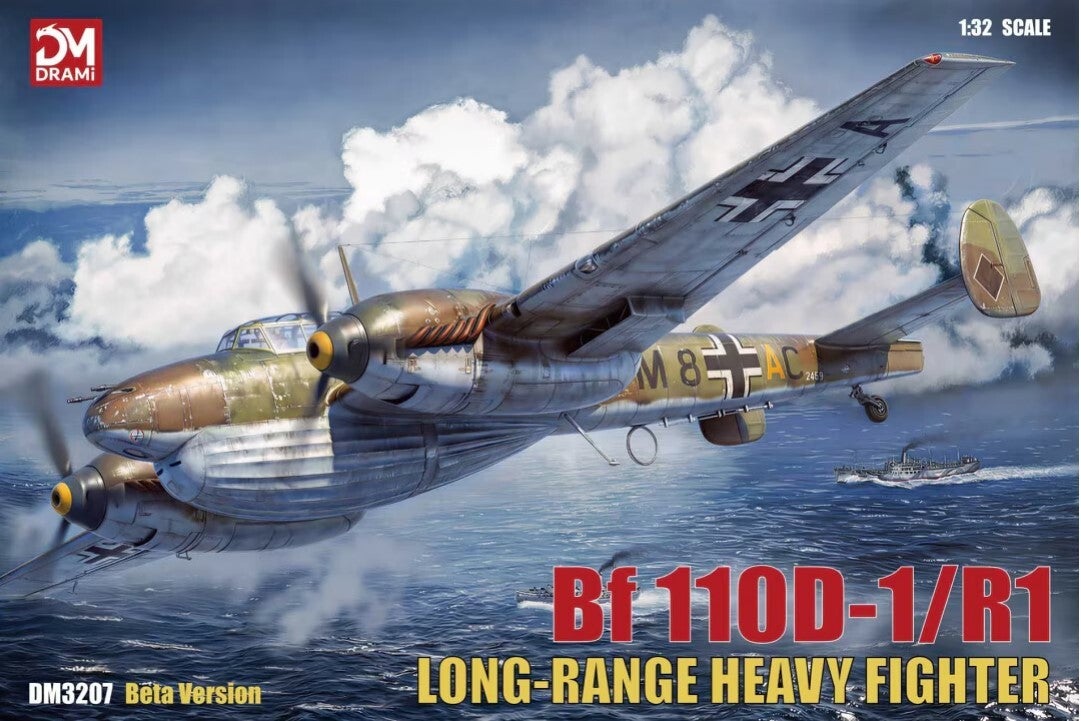
Plastic model kit of a Messerschmitt Bf 110 D-1/R1 "Dackelbauch" (Dachshund Belly)
1:32 scale
Includes clear parts and photo-etched parts
Fuselage:
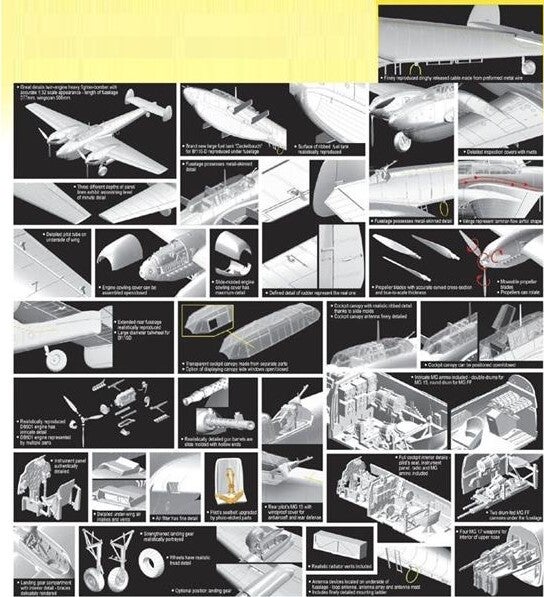
Large, conformal auxiliary fuel tank ("Dackelbauch") mounted under the fuselage for the Bf 110D
Realistic reproduction of the ribbed surface of the auxiliary tank
Finely detailed release cable for the life raft, made from pre-formed metal wire
Realistic representation of the extended rear fuselage
Fuselage features detailed metal plating texture
Two MG FF cannons with drum magazines located under the fuselage
Antenna equipment on the underside of the fuselage – frame antenna, antenna array, and antenna mast
Includes a finely detailed boarding ladder
Cockpit canopy and interior:
Cockpit canopy features a realistic ribbed structure (achieved via slide-mold technology)
Finely detailed antenna on the cockpit canopy
Cockpit canopy can be assembled in either an open or closed position
Transparent cockpit canopy composed of separate parts
Side cockpit windows can be displayed open or closed
Fully detailed interior – including pilot's seat, instrument panel, radio equipment, and machine gun ammunition
Pilot seat harnesses enhanced with photo-etched parts
Authentically detailed instrument panel
Four MG 17 machine guns for the forward fuselage section
Realistically rendered gun barrels, manufactured using slide-mold technology with hollow muzzles
Detailed machine gun ammunition included – twin drums for the MG 15, circular drums for the MG FF
Includes an MG 15 for the rear gunner Windscreen cover for use against aerial and ground targets
Realistically designed radiator flaps
Wings:
Engravings in three different depths provide an astonishing level of detail
Detailed maintenance hatches with rivet representations
Precisely crafted details on the rudder, modeled after the original
Wings featuring a laminar airfoil design
Detailed Pitot tube on the underside of the wing
Finely crafted air filter
Detailed air intakes and ventilation openings on the underside of the wing
Engine and propeller blades:
Highly detailed engine cowling, produced using slide-mold technology
Engine cowling can be assembled in either an open or closed position
Realistically replicated DB 601 engine with numerous details
DB 601 engine assembled from multiple individual parts
Propeller blades with a correct, curved cross-section and scale-accurate thickness
Movable propeller blades
Rotating propeller
Landing gear:
Large tail wheel for the Bf110D
Wheels with realistic tread patterns
Reinforced landing gear depicted realistically
Landing gear can be assembled in either the extended or retracted position
Wheel well with detailed interior—intricate struts
Detailed tail wheel
Unbuilt, unpainted
Paint and glue not included
One of the most famous German fighter aircraft of the Second World War was the Messerschmitt Bf110, a twin-engine heavy fighter (referred to as a "Zerstörer" or "destroyer"), which was later developed into a fighter-bomber and, ultimately, the primary night fighter of the Luftwaffe. The Bf110C was the first major production version of this aircraft type; the desire to increase its range led to the Bf110D, a "long-range destroyer" (*Langstrecken-Zerstörer*) variant. Based on the Bf110C, this extended-range version was equipped with external fuel tanks—such as 900-liter underwing tanks or the so-called "Dackelbauch" ("dachshund belly") tank. The latter occasionally suffered from mysterious in-flight explosions, caused by inadequate venting that resulted in the formation of highly flammable fuel-air mixtures.
The Bf110D entered service just in time to participate in the Norwegian Campaign against British and French forces in the far north of the country. Subsequently, many of these aircraft were stationed in Norway, from where they carried out attacks on shipping as well as long-range sorties against the northern parts of Great Britain. The specific Bf110D-1/R-1—the first long-range variant—began service in May 1940. However, the bulky, 1,200-liter "Dackelbauch" auxiliary tank mounted beneath the fuselage compromised the aircraft's maneuverability.
---