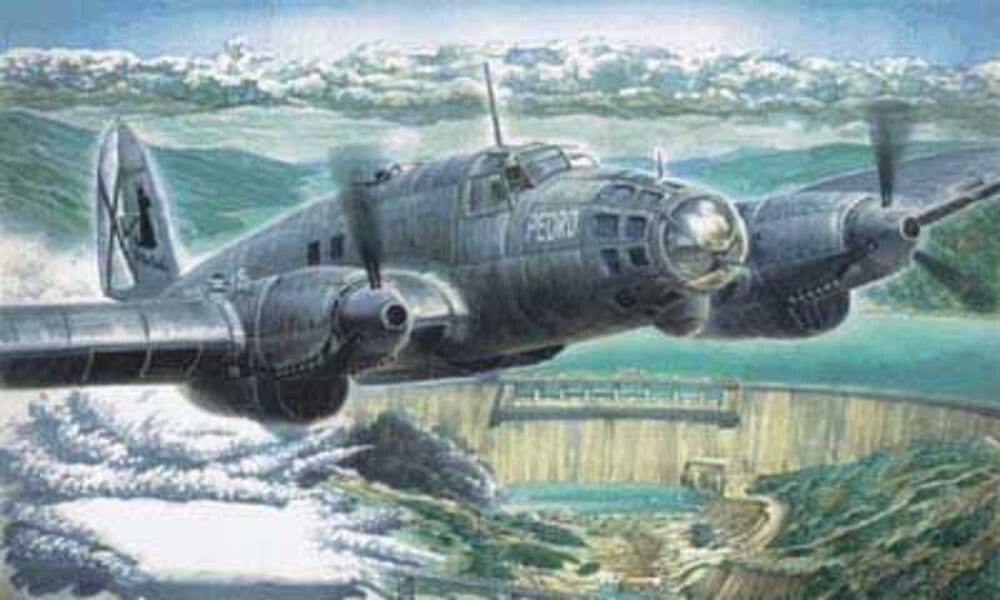
RODEN : REF : 005 : 1:72 : AIRCRAFT KIT : German : HEINKEL : 111B ''Pedro''
RODEN REF :
005
Manufacturer :
RODEN MODEL (Ukraine).
GTIN : 4820015440303.
Scale :
1:72
---
History
Only a few planes in WWII aviation history deserved to be called "Great". One of them was the Heinkel He-111. The unsuccessful debut of the first production version of the He 111A was not a disappointment for Ernst Heinkel even though the aircraft was fitted with BMW VI engine, which caused the aircraft to be under powered. The Last of the five pre-production prototypes, He 111V5, was equipped with the new DB 600 engine. The aircraft competed its first take-off in May of 1936. With a full military load it reached a maximum cruising speed of 340 km/h (211 mph), and these results were considered very successful at the time. The RLM immediately ordered the first production batch; the first production samples being delivered to KG 154 "Boelcke". At the same time, in August of 1936, the Spanish Civil War began. The Republican Government received military help from the Soviet Union, Germany, and Italy, together they gave support to general Franko and his rebels. The Aviation part of this support consisted of a special group named the "Legion Condor". At first, the "Legion Condor" received only Ju 52 transport planes; because Germany declared that its support would be non-military in nature. But during this time the republicans had obtained new soviet-built bombers, which they called "Katyushka" (well known as the Tupolev SB), and Hermann Goring insisted on testing one of the new German bombers in real war conditions. The Spanish Civil War was an excellent occasion for trials concerning the new-generation of planes; the He 111B,Do 17E, and Ju 86D.
During February of 1937 the first four He 111B-1's as well as the Do 17E and Ju 86D arrived from Hamburg. These bombers made up the " Versuchsbomberstaffel" (Experimental Bomber squadron) and operated in the K/88 bomb group. In a short time the He 111B had won a reputation as the "Best of the bombers", and was separated and put into an individual sub-flight with the semi-official name "Pedro". This name would have all the planes together with individual aircraft numbers.
In March 1937 the "Pedro's" achieved their first success in battle, when attacking a Republican airfield near Alcals de Henares. The group destroyed 24 enemy planes on the ground. Later the "Pedro's" took part in the famous raid on Guernica, which came into history as a symbol of brutality and cruelty, more than 1,500 civilians were killed.
The He 111B served in the "Legion Condor" until mid 1938, when they were re-equipped with the more modern He 111E. The majority of the He 111B's were lost in action; others were withdrawn from service in connection with a considerable amount of damage.
The bloody experience of the Spanish War confirmed that the He 111 would have a potential for large battle campaigns. Massive serial production started in the Dornierwerke (at Wismar), Arado Flugzlugwerke (at Babelsberg), and Algemeine Transportgesell-shaft (in Leipzig); besides, the new Heinkel plant was quickly built at Oranienburg (near North Berlin). Less than a year later, weekly production of He 111 would be 100 aircraft. From the first days of World War II until the end, the He 111 would be the main Luftwaffe medium bomber.
---
Histoire
Dans l'histoire de l'aviation de la Seconde Guerre mondiale, rares sont les appareils qui méritent d'être qualifiés de « grands ». Le Heinkel He 111 est l'un d'entre eux. Les débuts difficiles de la première version de série, le He 111A, ne découragèrent pas Ernst Heinkel, bien que l'appareil, équipé de moteurs BMW VI, manquât cruellement de puissance. Le dernier des cinq prototypes de pré-série, le He 111V5, fut doté du nouveau moteur DB 600. Il effectua son premier vol en mai 1936. Avec une charge militaire complète, il atteignait une vitesse de croisière maximale de 340 km/h, des performances jugées très satisfaisantes pour l'époque. Le RLM (ministère de l'Aviation du Reich) passa immédiatement commande d'un premier lot de production ; les premiers exemplaires furent livrés à la KG 154 « Boelcke ». Parallèlement, en août 1936, éclata la guerre civile espagnole. Le gouvernement républicain reçut une aide militaire, tandis que le général Franco et ses insurgés bénéficièrent du soutien de l'Allemagne et de l'Italie. Le volet aérien de cette intervention allemande prit la forme d'une unité spéciale baptisée « Légion Condor ». Initialement, la « Légion Condor » ne fut dotée que d'avions de transport Ju 52, l'Allemagne affirmant que son soutien n'était pas de nature militaire. Cependant, les républicains ayant acquis de nouveaux bombardiers de fabrication soviétique — surnommés « Katiouchka » (en réalité des Tupolev SB) —, Hermann Göring insista pour tester les nouveaux bombardiers allemands en conditions réelles de combat. La guerre civile espagnole offrit ainsi une occasion idéale pour éprouver la nouvelle génération d'appareils : les He 111B, Do 17E et Ju 86D.
En février 1937, les quatre premiers He 111B-1, accompagnés de Do 17E et de Ju 86D, arrivèrent en provenance de Hambourg. Ces bombardiers constituaient la « Versuchsbomberstaffel » (escadrille de bombardiers expérimentaux) et étaient intégrés au groupe de bombardement K/88. En peu de temps, le He 111B s'imposa comme le « meilleur des bombardiers » ; il fut alors isolé au sein d'une sous-unité distincte, désignée de manière semi-officielle sous le nom de « Pedro ». Cette appellation s'appliquait à l'ensemble des appareils, qui portaient chacun un numéro d'identification individuel.
En mars 1937, les « Pedro » remportèrent leur premier succès au combat lors d'une attaque contre un aérodrome républicain près d'Alcalá de Henares, détruisant 24 avions ennemis au sol. Plus tard, ils prirent part au célèbre raid sur Guernica — resté dans l'histoire comme un symbole de brutalité et de cruauté, ayant coûté la vie à plus de 1 500 civils.
Le He 111B fut utilisé au sein de la « Légion Condor » jusqu'à la mi-1938, date à laquelle il fut remplacé par le He 111E, un modèle plus moderne. La majeure partie des He 111B fut perdue au combat ; les autres furent retirés du service en raison des dommages importants qu'ils avaient subis.
L'expérience sanglante de la guerre d'Espagne confirma que le He 111 possédait un potentiel adapté aux campagnes militaires de grande envergure. Une production en série à grande échelle fut lancée dans les usines Dornierwerke (à Wismar), Arado Flugzeugwerke (à Babelsberg) et Allgemeine Transportgesellschaft (à Leipzig) ; par ailleurs, une nouvelle usine Heinkel fut rapidement construite à Oranienburg, près de Berlin. Moins d'un an plus tard, la production hebdomadaire de He 111 atteignait 100 appareils. Du début à la fin de la Seconde Guerre mondiale, le He 111 demeura le principal bombardier moyen de la Luftwaffe.
---
Sources : Roden Website.