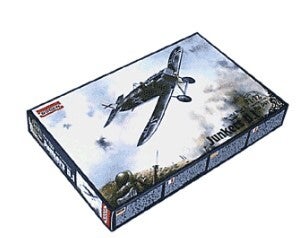
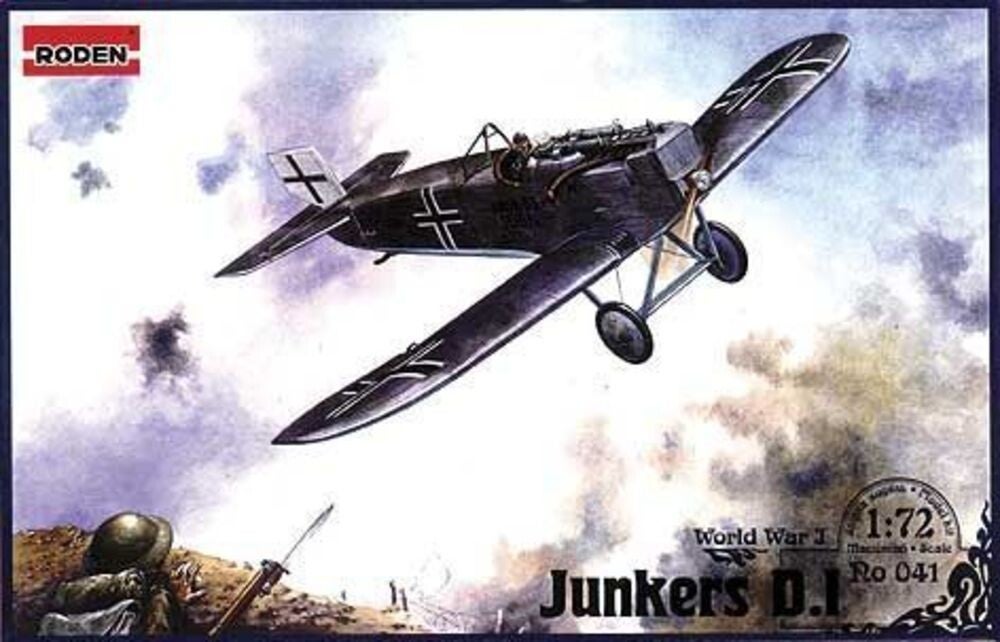
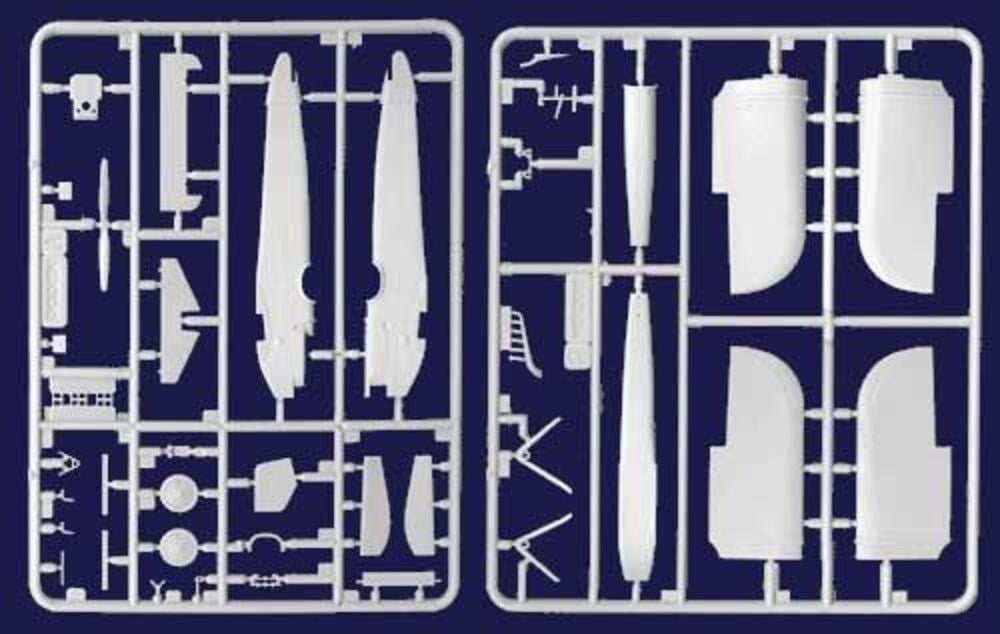
RODEN : REF : 041 : 1:72 : AIRCRAFT KIT : German (Empire) : JUNKERS : D.I (WWI)
RODEN REF :
041
Manufacturer :
RODEN MODEL (Ukraine).
GTIN : 4823017700444.
Scale :
1:72
---
History :
The rapid development of aviation during the First World War was mainly aimed at improving the principal characteristics of aircraft-speed, maneuverability, and range. Structurally, airplanes of that period remained descendants of the Wright brothers' very first flying machine-they were still produced from the traditional materials of wood and canvas; structural strength was attained with the help of numerous bracing wires. But there were certain particular warplanes, some of which barely had time to take part in combat, essentially differed from all the rest-the Junkers J I, Junkers CL I and Junkers D I. These airplanes were of a completely new type. They were a great advance for there time-their design consisted entirely of metal. Their design fundamentals were simple-a framework of thin duraluminum tubes was covered with sheets of corrugated aluminium. The ingenious German designer and inventor Hugo Junkers patented this idea in 1912. It became the basis of his theoretical development "of a thick cantilevered wing". After the beginning of the First World War Junkers convinced Idflieg of the potential of his development. The Junkers J I, a heavily armored ground attack plane, made its first flight in the winter of 1916. This airplane has become famous, because none of the Allies could bring down any of these machines during the war.
Convinced of the correctness of this development, Junkers began designing a special operational-support plane for the army, the CL I; and a fighter, the D I.
The first flight of the J.7, prototype of the future fighter, was in September 1917. The revolutionary design was confronted by a great variety of problems, which were atypical of conventional aircraft-vibration of wings in flight, bad controllability of ailerons, amongst others. But the biggest problem was the absence of a suitable engine, because the best engine was the Mercedes D.IIIa, which developed only 160 hp. It was enough for a traditional machine, but the completely new metal design was much heavier. Nevertheless, the aircraft was sound and not meant for aerobatics, so Junkers persevered with the new technology.
During the Second Fighter Competition in July 1918, Junkers entered into competition not only the J.7, but also the new J.9 (D I), with many modifications to the overall design: the shape of the fuselage was changed, the wing span was increased, and the ailerons also were of changed form. The greatest pilots participated in these Competitions, and their observations about the metal machines did appear disapproving-Bruno Loerzer and Hermann Goering recommended it strictly as "an airplane for struggle with balloons and airships". This low-wing monoplane, an unusual design for the time, naturally had a limited view downwards from the cockpit, and this also has resulted in disapproval from the pilots. Nevertheless the Idflieg ordered a series of 40 aircraft, but by the end of the war the Junkers firm had built only 15 machines (12 by February 1919, when all military production was stopped by order of the Allies). The affiliated company, Junkers-Fokker, constructed 13 machines of the D I type. The first aircraft had long fuselages (later ones were to the shorter design). In the beginning of October 1918 these machines were sent to the Flanders sector, but the war approached its end and the Junkers D I was not in time to take much part in the fighting. In conditions of autumn rain Junkers' aircraft had essential advantages over wood and linen types-metal machines were not subject to the whims of the weather, while the canvas and wood of other machines deteriorated all too quickly.
After the end of the war the Junkers aircraft had an opportunity once again to prove their advantages: German air forces assisted the governments of the Baltic countries in their struggle against Russia in the spring of 1919. The commander of the division, Lt. Gotthard Sachsenberg, remarked that the metal Junkers D I was the best choice for the constantly adverse weather conditions.
Without doubt only two events were truly radical advances in aircraft technology during the First World war-the invention of the gun synchronizer, and the creation of completely metal aircraft designs. The further development of fighter aviation was determined by these two events, and consequently Hugo Junkers rightfully became regarded as one of the parents of modern aircraft.
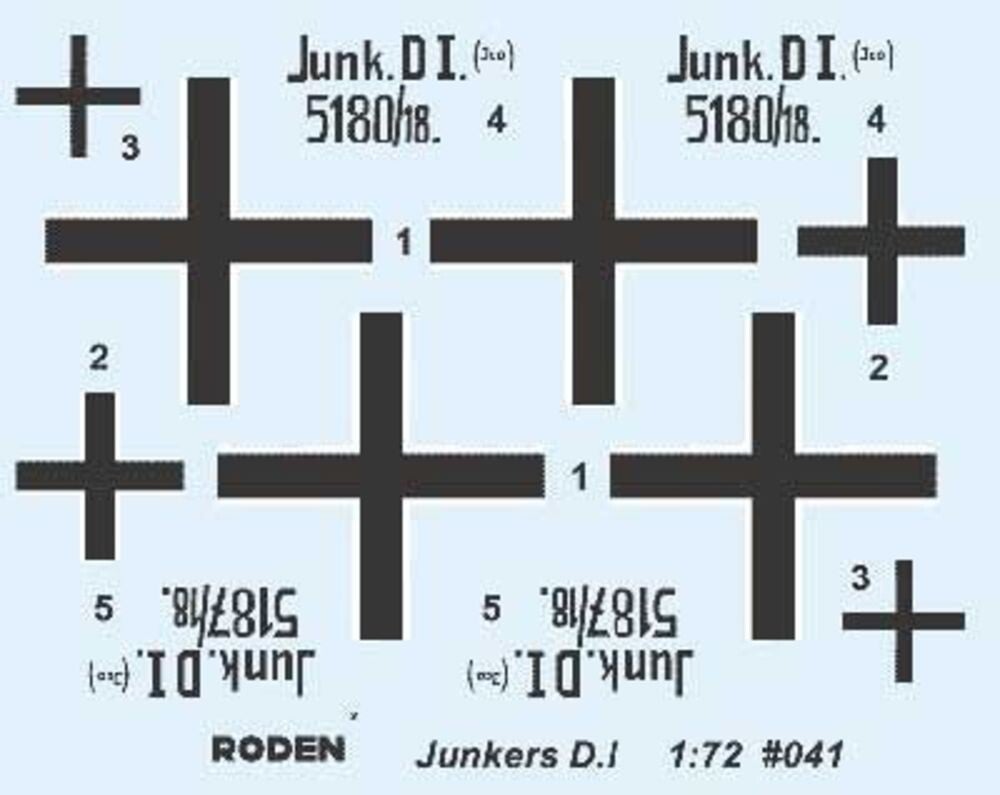
Junkers DI, w/n 5180/18, German Air Force, Western Front, Autumn 1918.
Junkers DI, w/n 5187/18, German Air Force, Western Front, Autumn 1918.
---
Histoire :
Le développement rapide de l'aviation durant la Première Guerre mondiale visait principalement à améliorer les caractéristiques fondamentales des aéronefs : vitesse, maniabilité et autonomie. Sur le plan structurel, les avions de cette époque restaient les héritiers directs de la toute première machine volante des frères Wright ; ils étaient encore fabriqués à partir de matériaux traditionnels, tels que le bois et la toile, et leur solidité structurelle était assurée par un réseau complexe de haubans. Cependant, certains appareils militaires — dont quelques-uns eurent à peine le temps de participer aux combats — se distinguaient nettement des autres : les Junkers J I, Junkers CL I et Junkers D I. Ces avions représentaient un type totalement inédit. Véritable avancée pour leur époque, ils étaient entièrement conçus en métal. Leur principe de construction était simple : une ossature composée de fins tubes en duralumin, recouverte de tôles d'aluminium ondulé. L'ingénieux concepteur et inventeur allemand Hugo Junkers avait breveté ce concept dès 1912. Il servit de fondement à ses travaux théoriques sur « l'aile épaisse en porte-à-faux ». Après le déclenchement de la Première Guerre mondiale, Junkers parvint à convaincre l'Idflieg du potentiel de ses recherches. Le Junkers J I, un avion d'attaque au sol fortement blindé, effectua son premier vol durant l'hiver 1916. Cet appareil devint célèbre, car aucun exemplaire ne fut abattu par les Alliés durant tout le conflit.
Convaincu de la pertinence de son approche, Junkers entreprit la conception du CL I, un appareil destiné au soutien opérationnel des troupes, ainsi que du D I, un avion de chasse.
Le premier vol du J.7, prototype du futur chasseur, eut lieu en septembre 1917. Cette conception révolutionnaire se heurta à divers problèmes, atypiques pour les appareils de l'époque — notamment des vibrations des ailes en vol et une mauvaise maniabilité des ailerons. Mais le défi majeur résidait dans l'absence de moteur adapté : le meilleur propulseur disponible, le Mercedes D.IIIa, ne développait que 160 ch. Si cette puissance suffisait pour un appareil de conception traditionnelle, elle s'avérait insuffisante pour cette nouvelle structure métallique, nettement plus lourde. Néanmoins, l'appareil était robuste et, bien qu'il ne fût pas conçu pour la voltige, Junkers persévéra dans l'utilisation de cette nouvelle technologie.
Lors du deuxième concours de chasse en juillet 1918, Junkers présenta non seulement le J.7, mais aussi le nouveau J.9 (D I), qui intégrait de nombreuses modifications par rapport à la conception initiale : la forme du fuselage fut revue, l'envergure augmentée et la géométrie des ailerons modifiée. Les plus grands pilotes prirent part à ces épreuves, mais leurs commentaires sur ces appareils métalliques furent plutôt critiques ; Bruno Loerzer et Hermann Göring, notamment, les jugèrent adaptés uniquement à « la lutte contre les ballons et les dirigeables ». Ce monoplan à aile basse, à la conception inhabituelle pour l'époque, offrait une visibilité vers le bas limitée depuis le cockpit, ce qui suscita également le mécontentement des pilotes. Malgré cela, l'Idflieg commanda une série de 40 appareils ; toutefois, à la fin de la guerre, la firme Junkers n'en avait construit que 15 (dont 12 avant février 1919, date à laquelle toute production militaire fut interrompue sur ordre des Alliés). La société affiliée, Junkers-Fokker, en produisit 13 exemplaires du type D I. Les premiers appareils étaient dotés d'un fuselage long, tandis que les suivants adoptèrent une conception plus courte. Début octobre 1918, ces machines furent envoyées sur le front des Flandres, mais la guerre touchant à sa fin, le Junkers D I n'eut guère l'occasion de participer aux combats. Dans les conditions pluvieuses de l'automne, les appareils Junkers présentaient des avantages déterminants par rapport aux modèles en bois et en toile : les machines métalliques ne craignaient pas les caprices de la météo, alors que la toile et le bois des autres appareils se détérioraient très rapidement.
Après la fin du conflit, les avions Junkers eurent une nouvelle fois l'occasion de démontrer leurs atouts : au printemps 1919, les forces aériennes allemandes apportèrent leur soutien aux gouvernements des pays baltes dans leur lutte contre la Russie. Le commandant de division, le lieutenant Gotthard Sachsenberg, souligna alors que le Junkers D I, grâce à sa construction métallique, constituait le meilleur choix face à des conditions météorologiques constamment défavorables. Il ne fait aucun doute que seuls deux événements ont constitué des avancées réellement radicales dans la technologie aéronautique durant la Première Guerre mondiale : l’invention du mécanisme de synchronisation des mitrailleuses et la conception d’appareils entièrement métalliques. Le développement ultérieur de l’aviation de chasse a été déterminé par ces deux avancées ; c’est pourquoi Hugo Junkers est, à juste titre, considéré comme l’un des pères de l’aéronautique moderne.
Junkers DI, n° de série 5180/18, aviation allemande, front de l’Ouest, automne 1918.
Junkers DI, n° de série 5187/18, aviation allemande, front de l’Ouest, automne 1918.
---
Sources : Roden Website.