RODEN : REF : 043 : 1:72 : AIRCRAFT KIT : UK (RAF) : BRISTOL : F.2B Fighter (WWI)
RODEN REF :
043
Manufacturer :
RODEN MODEL (Ukraine).
GTIN : 4823017700369.
Scale :
1:72
---
History :
The R.A.F. BE2c was the principal two-seat reconnaissance plane of the Royal Flying Corps, and its specifications seemed sufficient for the military authorities in the early part of WWI. However, the obsolescence of its design and the appearance of new machines in the adversary's air fleet made its replacement urgent. The unfavorable military situation, in which Britain had lost its initiative in the skies of the Western Front, forced the military command to look for support among private firms. One of them, the Bristol Aeroplane Company, had a project for the construction of a two-seat general-purpose aircraft, which could be, used both ways: as a reconnaissance plane, and also in the tight maneuvers of air battles.
The prototype F2A with a Rolls-Royce Falcon engine made its first flight in September 1916. By the end of the same year, 50 planes were transferred to 48 Squadron of the Royal Flying Corps. To start with, the F2A was used as a regular two-seat fighter plane and this led to fatal consequences: during the first operational flight four planes out of six were lost.
In spite of this initial failure, the Bristol Company obtained a new order - this time for 200 machines. After some minor design changes, the F2B appeared, receiving a simple name: "Fighter".
Along with the appearance of the F2B, the use of the plane changed - now it was flown according to the tactics developed for single-seat planes. However, the strength of its construction and its ability to defend the rear hemisphere were indisputable advantages of the design.
The F2B quickly became popular among its pilots who nicknamed this plane 'Brisfit'. The quantity of new machines was growing rapidly - soon these planes were delivered not only to Front Line units, but also to Home Defence.
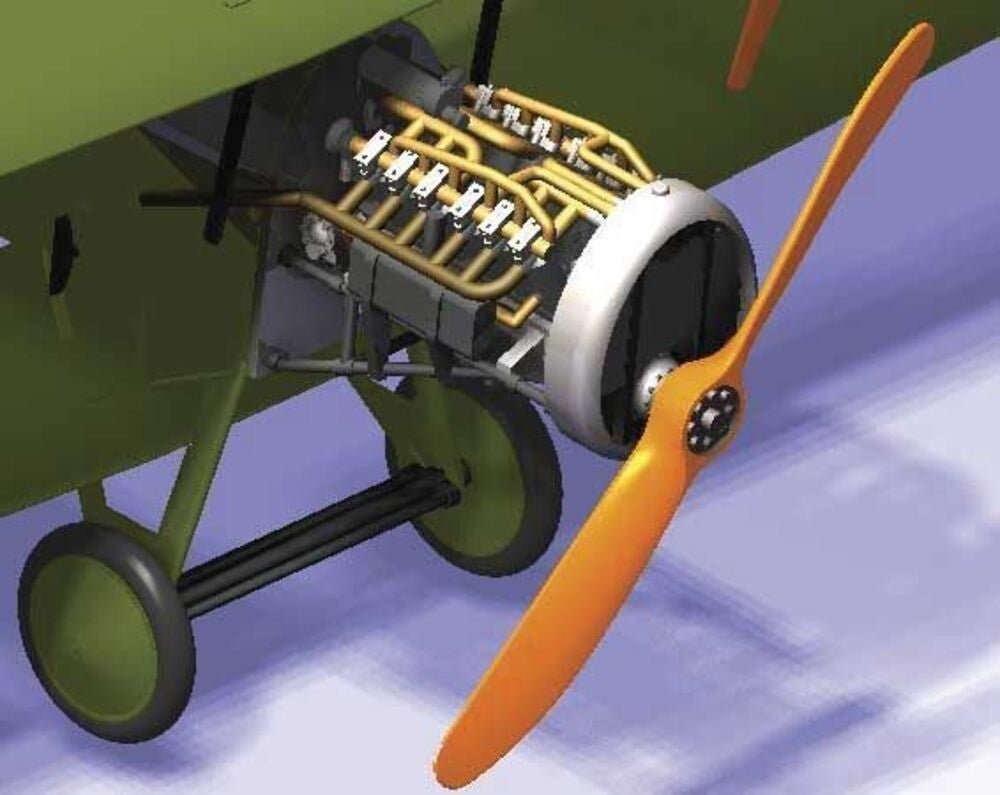
However, numerous problems with the engine seriously held back attempts to increase production of the type. The Bristol Company was forced to look for a substitute for the Falcon. Attempts to fit Hispano Suiza, Puma and Sunbeam Arab engines all failed (only the last one of them was built as a series modification). For this reason most F2B Fighters had a Rolls-Royce Falcon engine.
Apart from on the Western Front, the Bristol Fighter was widely used in other theaters of war; in Italy and Palestine. Aircraft serving with Home Defence managed to shoot down at least two German Gotha G.V strategic bombers.
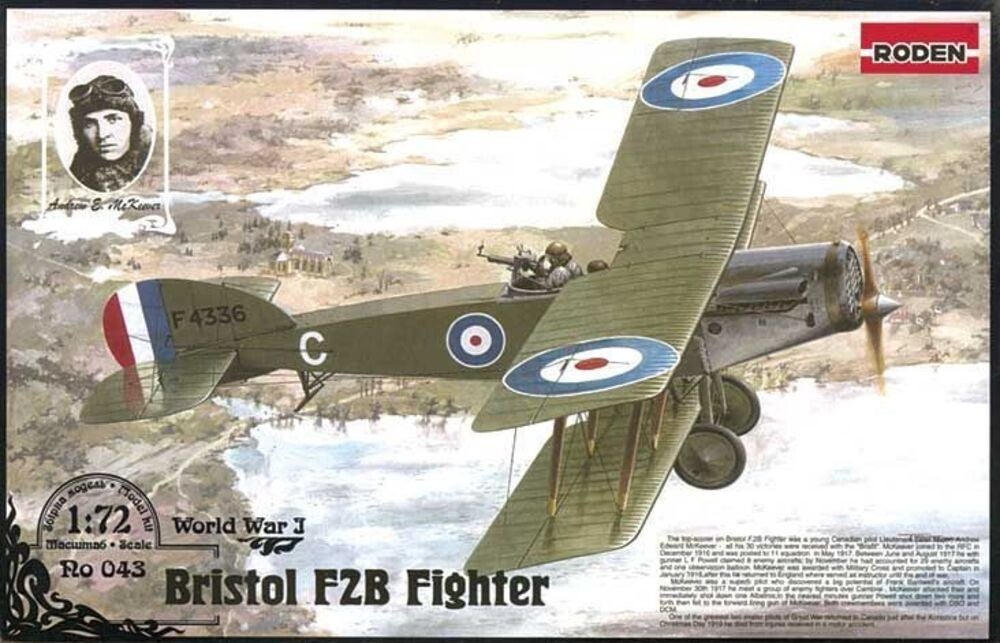
The most successful pilot to fly the Bristol F2B Fighter was the Canadian Andrew Edward McKeever - all of his 30 victories were won solely with this type. Another famous Canadian ace William Barker also flew the F2B. By the end of WWI the Bristol Company had received orders for 5,500 of these planes, 3,101 of which were transferred to combat units. After the Armistice, the additional contracts were cancelled. Altogether, taking into account later modifications and experimental examples, the total of machines built reached 4,747.
Apart from Great Britain, the Bristol F2B Fighter was used by the Air Forces of several other countries - Ireland, Poland, Belgium, Spain and Greece.
Such British dominions as Canada, Australia, New Zealand and the South African Union used the Bristol F2B Fighter in their air fleets.
Some of these planes remained in service until 1939. Thus, the Bristol F2B Fighter, designed during the WWI, faced another major world conflict, but this was a time for aircraft belonging to a new generation.
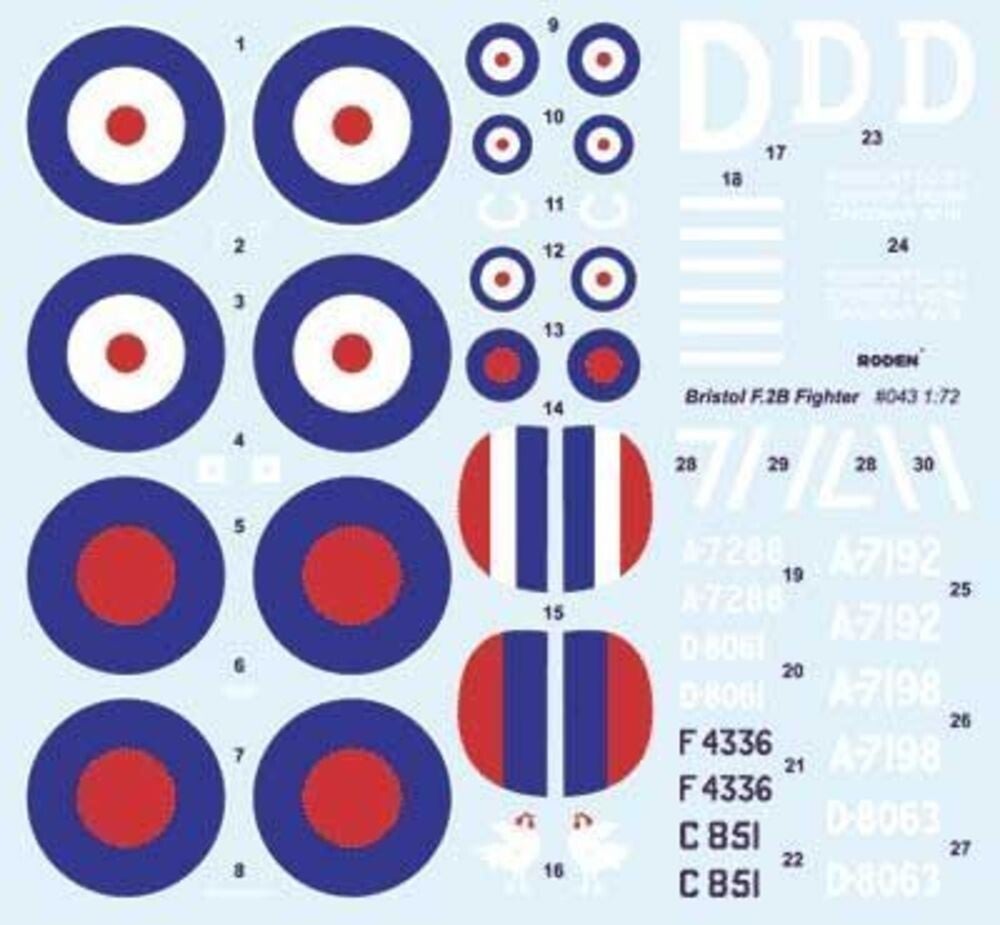
Bristol F.2B Fighter F4336, Second line of the RAF, Captain Andrew Edward McKeever (30 victories), October 1918.
Bristol F.2B Fighter A7288/7, No.11 Sqn RFC, Western Front, Lt Andrew Edward McKeever, observer/gunner - Lt L F Powell, November 1917.
Bristol F.2B Fighter D8061, No.48 Sqn RAF, Western Front, Mericourt, Lt FN Griffiths, observer/gunner - AE Ansell, July 1918.
Bristol F.2B Fighter À7198, No. 1 Sqn Australian Flying Corps, captain R Williams, 1918.
Bristol F.2B Fighter C851, No.141(HD) Sqn, Lt E E Turner, observer/gunner - H B Barwise, May 1918; on the night 19/20 May shot down Gotha G.V 979/16 of Bogohl 3.
Bristol F.2B Fighter A7192, No. 1 Sqn Australian Flying Corps, Palestine, 1918.
Bristol F.2B Fighter D8063/D, No.139 Sqn RAF, Italian Front, Villaverla, Maj W G Barker, observer/gunner - HRH Prince Edward of Wales, summer 1918.
---
Histoire :
Le R.A.F. BE2c était le principal avion de reconnaissance biplace du Royal Flying Corps ; ses caractéristiques semblaient suffisantes aux autorités militaires au début de la Première Guerre mondiale. Cependant, la conception obsolète de l'appareil et l'apparition de nouveaux modèles au sein de la flotte aérienne adverse rendirent son remplacement urgent. La situation militaire défavorable, marquée par la perte de l'initiative britannique dans le ciel du front de l'Ouest, contraignit le commandement militaire à solliciter le soutien d'entreprises privées. L'une d'elles, la Bristol Aeroplane Company, travaillait sur un projet d'avion biplace polyvalent, conçu pour remplir deux rôles : la reconnaissance et le combat aérien, ce dernier exigeant une grande maniabilité.
Le prototype F2A, équipé d'un moteur Rolls-Royce Falcon, effectua son premier vol en septembre 1916. À la fin de la même année, 50 exemplaires furent affectés au 48e escadron du Royal Flying Corps. Initialement, le F2A fut utilisé comme un chasseur biplace classique, ce qui eut des conséquences désastreuses : lors de la première mission opérationnelle, quatre appareils sur six furent perdus.
Malgré cet échec initial, la société Bristol obtint une nouvelle commande, portant cette fois sur 200 unités. Après quelques modifications mineures de conception, le F2B vit le jour, recevant une appellation simple : « Fighter ».
Avec l'arrivée du F2B, l'utilisation de l'appareil évolua : il fut désormais employé selon des tactiques conçues pour les chasseurs monoplaces. Néanmoins, la robustesse de sa structure et sa capacité à défendre son secteur arrière constituaient des atouts indéniables.
Le F2B devint rapidement populaire auprès de ses pilotes, qui le surnommèrent « Brisfit ». Le nombre d'appareils en service augmenta rapidement ; ils furent bientôt distribués non seulement aux unités combattantes sur le front, mais aussi aux unités chargées de la défense du territoire national.
Toutefois, des problèmes récurrents liés au moteur entravèrent sérieusement les efforts visant à accroître la production de ce modèle. La société Bristol se vit contrainte de rechercher un remplaçant au moteur Falcon. Les tentatives d'installation de moteurs Hispano-Suiza, Puma et Sunbeam Arab se soldèrent toutes par des échecs (seul ce dernier fit l'objet d'une modification en série). C'est pourquoi la plupart des Bristol F2B furent équipés d'un moteur Rolls-Royce Falcon.
Outre le front de l'Ouest, le Bristol Fighter fut largement utilisé sur d'autres théâtres d'opérations, notamment en Italie et en Palestine. Les appareils affectés à la défense du territoire britannique (Home Defence) parvinrent à abattre au moins deux bombardiers stratégiques allemands Gotha G.V.
Le pilote ayant obtenu le plus grand succès aux commandes du Bristol F2B fut le Canadien Andrew Edward McKeever ; il remporta la totalité de ses 30 victoires sur ce type d'appareil. Un autre as canadien célèbre, William Barker, pilota également le F2B. À la fin de la Première Guerre mondiale, la société Bristol avait reçu des commandes pour 5 500 exemplaires, dont 3 101 furent affectés à des unités combattantes. Après l'Armistice, les contrats restants furent annulés. Au total, en incluant les modifications ultérieures et les exemplaires expérimentaux, 4 747 appareils furent construits.
Outre la Grande-Bretagne, le Bristol F2B fut utilisé par les forces aériennes de plusieurs autres pays : l'Irlande, la Pologne, la Belgique, l'Espagne et la Grèce.
Des dominions britanniques, tels que le Canada, l'Australie, la Nouvelle-Zélande et l'Union sud-africaine, intégrèrent également le Bristol F2B à leurs flottes aériennes.
Certains de ces appareils restèrent en service jusqu'en 1939. Ainsi, le Bristol F2B, conçu durant la Première Guerre mondiale, se retrouva confronté à un second conflit mondial majeur, bien que cette époque fût alors dominée par des aéronefs d'une nouvelle génération. Bristol F.2B Fighter F4336, unité de deuxième ligne de la RAF, capitaine Andrew Edward McKeever (30 victoires), octobre 1918.
Bristol F.2B Fighter A7288/7, 11e escadrille du RFC, front de l'Ouest, lieutenant Andrew Edward McKeever ; observateur/mitrailleur : lieutenant L. F. Powell, novembre 1917.
Bristol F.2B Fighter D8061, 48e escadrille de la RAF, front de l'Ouest, Méricourt, lieutenant F. N. Griffiths ; observateur/mitrailleur : A. E. Ansell, juillet 1918.
Bristol F.2B Fighter A7198, 1re escadrille de l'Australian Flying Corps, capitaine R. Williams, 1918.
Bristol F.2B Fighter C851, 141e escadrille (défense intérieure), lieutenant E. E. Turner ; observateur/mitrailleur : H. B. Barwise, mai 1918 ; dans la nuit du 19 au 20 mai, a abattu un Gotha G.V (979/16) du Bogohl 3.
Bristol F.2B Fighter A7192, 1re escadrille de l'Australian Flying Corps, Palestine, 1918.
Bristol F.2B Fighter D8063/D, 139e escadrille de la RAF, front italien, Villaverla, commandant W. G. Barker ; observateur/mitrailleur : S.A.R. le prince Édouard de Galles, été 1918.
---
Sources : Roden Website.