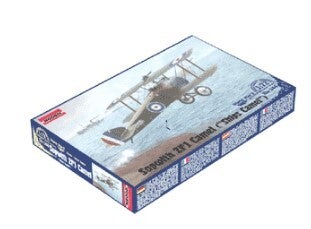
RODEN : REF : 044 : 1:72 : AIRCRAFT KIT : UK (RAF) : S.A.C. : Sopwith 2F1 Camel (WWI)
RODEN REF :
044
Manufacturer :
RODEN MODEL (Ukraine).
GTIN : 4823017700468.
Scale :
1:72
---
SAC = Sopwith Aviation Company.
---
History :
At the end of 1916 the prototype of the Sopwith F1 Camel fighter successfully passed its flight tests and was ordered in quantity for RFC and RNAS requirements. At the same time, separate experiments were being conducted with the famous Sopwith Pup, flying off and landing on the deck of a destroyer (the 'Ship's Pup').
Seeing that the Camel improved on the Pup in every respect, it was decided to develop a version which could be operated at sea. In the spring and summer of 1917 the fifth prototype, adapted from the normal F1, underwent tests on the Isle of Grain.
There were some essential differences from the standard Camel: first of all, the rear fuselage was detachable, at a point behind the pilot's position, in order to facilitate the stowage of planes on the hangar decks of ships.
Another difference was in armament - there was a single Vickers gun ahead of the pilot, and in the center section cut out a Lewis gun was fitted, which could be lowered for reloading (the so-called Admiralty Top Plane Mounting). Inflatable air bags were mounted in the rear of the fuselage to serve as flotation gear. A further change involved the control column, which now had external control levers for the elevator cables.
The plane had narrower wings in comparison with the standard F1 Camel, by some 13 inches (0.33m). 2F1 Camel was official name of the plane, but quite often it was simply called the 'Ship's Camel'. Orders from Sopwith were followed by orders from a variety of other manufacturers: - Beardmore, Johnston, Hooper, and Clayton & Shuttleworth.
In October 1917 the production 2F1 started to appear in the fleet. Planes were transferred to the decks of cruisers such as HMS Manxman, and also the specially designed aircraft carrier HMS Furious, formerly a light battlecruiser; and some were based in coastal air stations around Britain. Overall, up to the end of the war 275 2F1 Camels were built-a small number in comparison with F1 Camel production.
Nevertheless, they featured in many notable scenes in the history of air combat in the First World War. On July 19th, 1918 seven 2F1 carried out the first successful carrier based air strike: having taken off from the deck of aircraft carrier HMS Furious they destroyed German Zeppelins L54 and L60 in their sheds at Tondern. Three weeks later on August 11th, Flight Sub-Lieutenant Stuart Culley shot down Zeppelin L53. After the end of the war the 2F1 very quickly disappeared from the decks of ships at sea. Some were presented to Canada, three more went to Latvia and one to Estonia where they were used until early 1920.
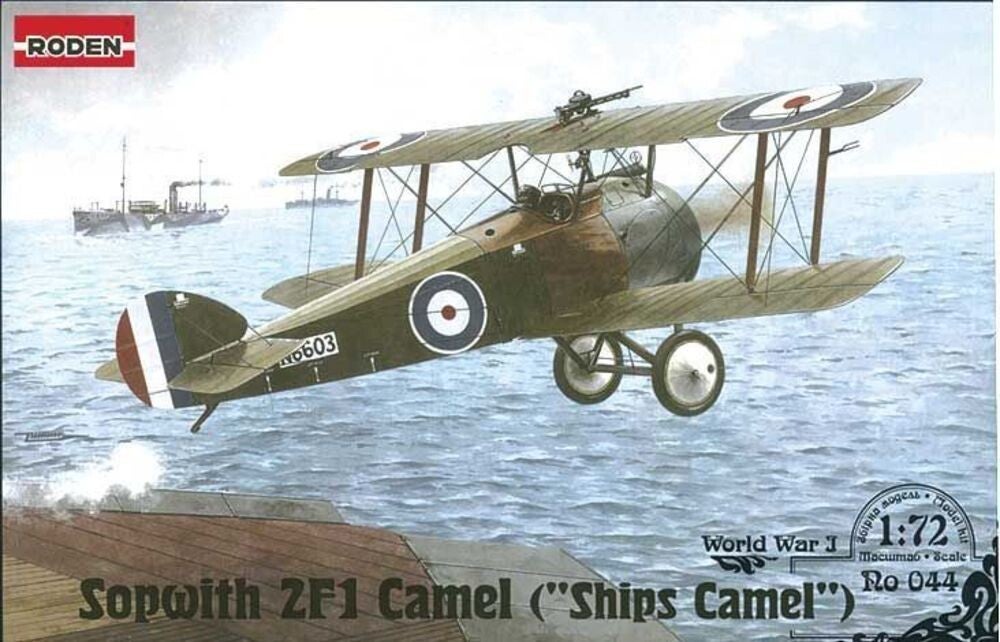
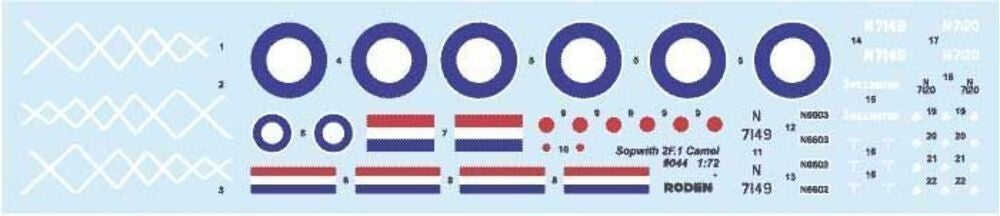
Sopwith 2F1 Camel, N6603, HMS Pegasus, 1918.
Sopwith 2F1 Camel, N6602, HMS Furious, 1918.
Sopwith 2F1 Camel, N7149, Turnhouse Naval School, 1918.
Sopwith 2F1 Camel, N7120, HMS Queen Elizabeth, 1918.
---
Historique :
Fin 1916, le prototype du chasseur Sopwith F1 Camel réussit ses essais en vol ; il fit alors l'objet d'une commande en série pour répondre aux besoins du RFC (Royal Flying Corps) et du RNAS (Royal Naval Air Service). Parallèlement, des expérimentations étaient menées avec le célèbre Sopwith Pup, consistant en des décollages et des atterrissages sur le pont d'un destroyer (appareil surnommé « Ship's Pup »).
Constatant que le Camel surpassait le Pup à tous égards, il fut décidé de développer une version adaptée aux opérations en mer. Au cours du printemps et de l'été 1917, le cinquième prototype — une variante du F1 standard — fut soumis à des essais sur l'île de Grain.
Cette version présentait des différences notables par rapport au Camel standard : tout d'abord, la partie arrière du fuselage était détachable (au niveau situé derrière le poste de pilotage), afin de faciliter le stockage des appareils dans les hangars des navires.
L'armement différait également : l'appareil était doté d'une mitrailleuse Vickers placée devant le pilote, tandis qu'une mitrailleuse Lewis était installée au niveau d'une découpe dans la section centrale de l'aile supérieure ; cette dernière pouvait être abaissée pour permettre le rechargement (dispositif connu sous le nom d'« Admiralty Top Plane Mounting »). Des coussins gonflables furent installés à l'arrière du fuselage pour assurer la flottabilité en cas d'amerrissage. Une autre modification concernait le manche à balai, désormais équipé de leviers externes pour actionner les câbles de profondeur.
L'envergure de l'appareil était réduite d'environ 13 pouces (0,33 m) par rapport à celle du F1 Camel standard. Bien que sa désignation officielle fût « 2F1 Camel », il était fréquemment appelé « Ship's Camel ». Outre les commandes passées auprès de Sopwith, d'autres contrats furent attribués à divers constructeurs, notamment Beardmore, Johnston, Hooper, ainsi que Clayton & Shuttleworth.
En octobre 1917, les premiers exemplaires du 2F1 entrèrent en service au sein de la flotte. Des appareils furent déployés sur les ponts de croiseurs, tels que le HMS Manxman, ainsi que sur le HMS Furious — un ancien croiseur de bataille léger reconverti en porte-avions. Par ailleurs, certains appareils furent affectés à des bases aéronavales côtières en Grande-Bretagne. Au total, 275 exemplaires du Sopwith 2F1 Camel furent construits jusqu’à la fin de la guerre ; un nombre modeste si on le compare à la production du modèle F1.
Néanmoins, ils furent les protagonistes de plusieurs épisodes marquants de l’histoire du combat aérien durant la Première Guerre mondiale. Le 19 juillet 1918, sept 2F1 menèrent avec succès la première opération aéronavale lancée depuis un porte-avions : après avoir décollé du pont du HMS Furious, ils détruisirent les zeppelins allemands L54 et L60 dans leurs hangars à Tondern. Trois semaines plus tard, le 11 août, le sous-lieutenant de l’aéronavale Stuart Culley abattit le zeppelin L53. Après la fin du conflit, les 2F1 disparurent très rapidement des ponts des navires en mer. Certains furent offerts au Canada, trois autres furent cédés à la Lettonie et un à l’Estonie, où ils restèrent en service jusqu’au début de l’année 1920.
Sopwith 2F1 Camel, N6603, HMS Pegasus, 1918.
Sopwith 2F1 Camel, N6602, HMS Furious, 1918.
Sopwith 2F1 Camel, N7149, école aéronavale de Turnhouse, 1918.
Sopwith 2F1 Camel, N7120, HMS Queen Elizabeth, 1918.
---
Sources : Roden Website.