RODEN : REF : 054 : 1:72 : AIRCRAFT KIT : UK (RAF) : S.A.C. : Sopwith T.F.1 Camel Two Seat Trainer (WWI)
RODEN REF :
054
Manufacturer :
RODEN MODEL (Ukraine).
GTIN : 4823017700673.
Scale :
1:72
---
History :
The introduction of the new Sopwith Camel fighter in 1917 was a famous event in the history of the Royal Flying Corps - it fast became the R.F.C.'s principal fighting plane and gained glory as the mount of many of Britain's 'warriors of the air'. It was a plane to be respected by its own pilots, and by the enemy's. But the Camel was very demanding in flight, and especially take off and landing, and while other planes also had their difficulties, in the Camel these stages of flight were risky operations.
This was a natural consequence of the fighter's design features - critically small dimensions, a rather high undercarriage and a narrow distance between the wheels; and notably the considerable moving mass of the rotary engine. For skilled pilots who had survived the severe flying school of the Western Front all of this did not represent a vital issue, but in 1917 the Royal Flying Corps dramatically increased in size and its fighting units received many more beginner pilots. During only one half year more than a hundred accidents occurred involving Sopwith Camels, and thirty pilots were lost. Beginners started to be afraid of the plane and gave it the derogatory nickname Swine - in other words, "ugly as a pig". In an attempt to tackle the situation, frontline squadron pilots tried converting the odd machine into two seat trainers, but these homemade products turned out to be too unstable in flight due to lack of attention to center of gravity issues.
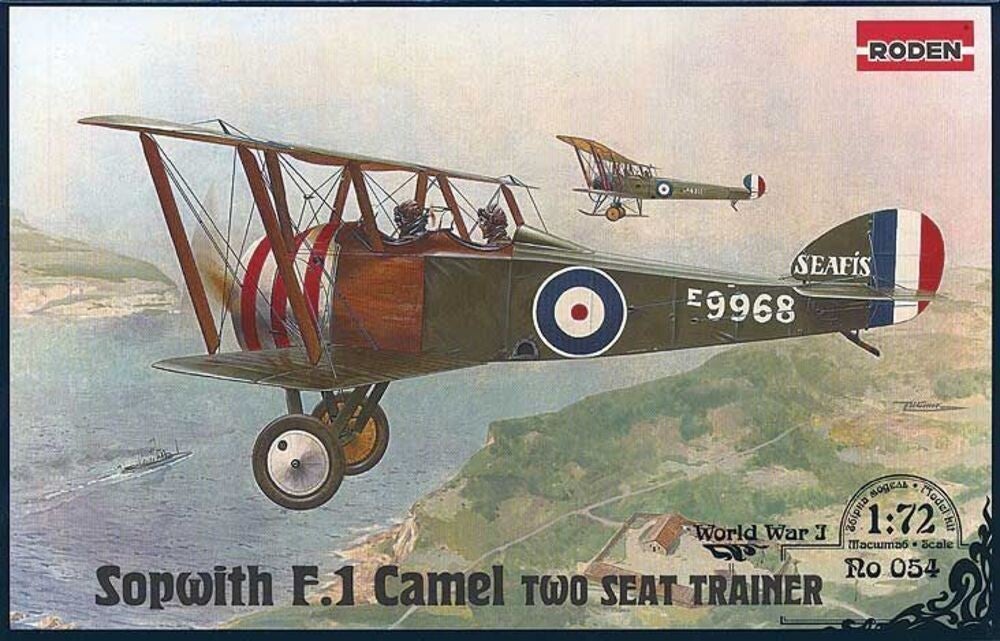
At the beginning of 1918, Sopwith Aviation paid attention to this urgent problem and made the necessary changes to the Camel design, developing it into a proper two seat training aircraft. The armament was removed; the fuel tank was greatly reduced, because training flights did not last more than 10-15 minutes; a forward cockpit was inserted several inches further forward and the rear cockpit was tightly closed up to it (yes, room for the pilot's legs in the rear seat were somewhat restricted). These innovations allowed the two seater to maintain stability in the air without undue risk of a fatal spin or of stalling. Certainly, the two seat Camel equipped with dual controls allowed the instructor to duplicate the actions of the pupil and supervise the flight.
The plane never received its own name - it was simply called the Camel Trainer. Having built a quantity of these two seat machines, useful numbers were then delivered to the training schools and other instructional centers. In the history of the Great War this small twin seat plane might have gone almost unnoticed, but it accomplished an important and noble mission - it achieved trust and respect for the Allies' best fighter, the fine and unsurpassed Sopwith Camel.
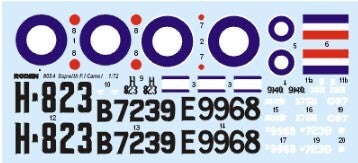
Sopwith Camel Trainer H823, No.43 Training depot Station at Chattis Hill, November 1918.
Sopwith Camel Trainer B7239, No.59 Training Depot Station at Cranwell, 1918-1919.
Sopwith Camel Trainer B7331 "North China Aeroplane", No.42 Training Squadron at Wye, February 1918.
Sopwith Camel Trainer B9140 "Johnatan. Presented by the Paramount Chief and Basuto Nation", No.42 Training Squadron at Wye, 1917-1918.
Sopwith Camel Trainer B3801 Prototype Official Conversion, 23rd Wing Aeroplane Repair section at South Carlton, 1917-1918.
Sopwith Camel Trainer C57 Naval Flying School at Eastbourne, flown by Istructor Pilot Captain A W Wood, April 1918.
Sopwith F.I Camel Two Seat Trainer, E9968,
South-Eastern Area Flying Instructors School at Shoreham, during 1918.
---
Histoire :
L'introduction du nouveau chasseur Sopwith Camel en 1917 marqua un tournant dans l'histoire du Royal Flying Corps (RFC). Il devint rapidement le principal appareil de combat du RFC et acquit une grande renommée en tant que monture de nombreux « guerriers du ciel » britanniques. C'était un avion qui imposait le respect, tant à ses propres pilotes qu'à ceux de l'ennemi. Cependant, le Camel se révélait très exigeant en vol, particulièrement lors des phases de décollage et d'atterrissage ; si d'autres appareils présentaient eux aussi des difficultés, ces étapes du vol constituaient, avec le Camel, des opérations périlleuses.
Cela découlait naturellement des caractéristiques de conception de l'appareil : des dimensions extrêmement réduites, un train d'atterrissage relativement haut avec un écartement étroit entre les roues, et surtout, la masse importante en mouvement du moteur rotatif. Pour les pilotes chevronnés, aguerris par les conditions éprouvantes du front occidental, ces particularités ne posaient pas de problème majeur. Toutefois, en 1917, le Royal Flying Corps connut une expansion rapide, et ses unités combattantes accueillirent un nombre croissant de pilotes novices. En l'espace de six mois seulement, plus d'une centaine d'accidents impliquant des Sopwith Camel furent recensés, coûtant la vie à trente pilotes. Les débutants commencèrent à redouter l'appareil, lui attribuant le surnom péjoratif de « Swine » (cochon) — sous-entendant qu'il était « laid comme un cochon ». Pour tenter de remédier à la situation, des pilotes d'escadrilles en première ligne entreprirent de transformer certains exemplaires en appareils d'entraînement biplaces ; mais ces modifications artisanales manquaient de stabilité en vol, faute d'avoir pris en compte les enjeux liés au centre de gravité.
Au début de l'année 1918, Sopwith Aviation se pencha sur ce problème urgent et apporta les modifications nécessaires à la conception du Camel, le transformant en un véritable avion d'entraînement biplace. L'armement fut retiré, et la capacité du réservoir de carburant fut considérablement réduite, les vols d'entraînement ne dépassant généralement pas 10 à 15 minutes. Un poste de pilotage fut ajouté vers l'avant, tandis que le poste arrière fut rapproché au plus près (l'espace réservé aux jambes du pilote, à l'arrière, s'en trouvait d'ailleurs quelque peu restreint). Ces innovations permirent à la version biplace de conserver une bonne stabilité en vol, limitant ainsi les risques de décrochage ou d'entrée en vrille fatale. Certes, le Camel biplace, doté de doubles commandes, permettait à l'instructeur de reproduire les actions de l'élève et de superviser le vol.
L'appareil ne reçut jamais de nom spécifique ; on l'appelait simplement « Camel Trainer ». Après la construction d'un certain nombre de ces machines biplaces, plusieurs exemplaires furent livrés aux écoles de pilotage et autres centres d'instruction. Dans l'histoire de la Grande Guerre, ce petit avion biplace aurait pu passer presque inaperçu ; pourtant, il accomplit une mission importante et noble : il contribua à renforcer la confiance et le respect envers le meilleur chasseur des Alliés, l'excellent et inégalé Sopwith Camel.
Sopwith Camel Trainer H823, 43e dépôt d'entraînement (Training Depot Station) à Chattis Hill, novembre 1918.
Sopwith Camel Trainer B7239, 59e dépôt d'entraînement (Training Depot Station) à Cranwell, 1918-1919.
Sopwith Camel Trainer B7331 « North China Aeroplane », 42e escadron d'entraînement (Training Squadron) à Wye, février 1918.
Sopwith Camel Trainer B9140 « Johnatan » — offert par le chef suprême et la nation basotho —, 42e escadron d'entraînement (Training Squadron) à Wye, 1917-1918.
Sopwith Camel Trainer B3801 (prototype issu d'une conversion officielle), section de réparation aéronautique de la 23e escadre (23rd Wing) à South Carlton, 1917-1918.
Sopwith Camel Trainer C57, école d'aviation navale (Naval Flying School) à Eastbourne ; piloté par l'instructeur, le capitaine A. W. Wood, en avril 1918.
Sopwith F.I Camel (version biplace d'entraînement), E9968,
École d'instructeurs de pilotage de la zone sud-est (South-Eastern Area Flying Instructors School) à Shoreham, en 1918.
---
Sources : Roden Website.