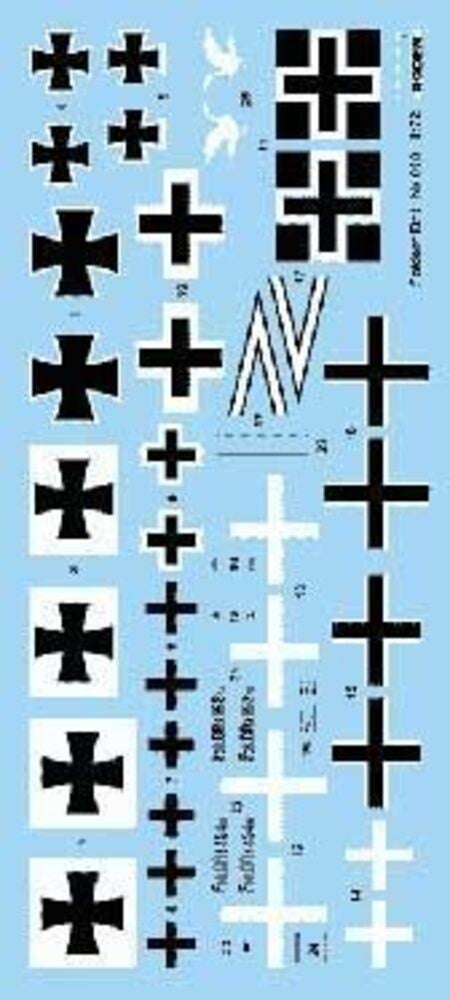
RODEN : REF : 010 : 1:72 : AIRCRAFT KIT : German (Empire) : Fokker Dr.I (WWI)
RODEN REF :
010
Manufacturer :
RODEN MODEL (Ukraine).
GTIN : 4820015440341.
Scale :
1:72
---
History :
The Fokker Dr.I, the most well known German fighter of WWI, came into history as "The Red Barons plane". Rittmeister Manfred Von Richthofen, the number one ace of WWI, with twenty planes claimed in the Dr.I (from 80 total air victories). The Fokker Dreidecker wasn't considered the best WWI plane, but it did receive the honor of "The most popular aircraft of all the German aces".
The Sopwith Triplane appearing in early 1917, became the new opponent to their Albatross D.III. The Fokker company, who was developing (at the same time) a new project; the D.VI biplane, received an order from the Idflieg for a new triplane aircraft. First, German air command proposed to copy the Sopwith Triplane (like Pfalz Flugzeugwerke previously had copied the Morane designs). But Anthony Fokker in the short term adopted the D.VI to triplane standards. In August of 1917, two pre-production aircraft reached the front for combat trials.
The new plane very quickly received the best performance reports from it pilots, especially for its incredible maneuverability. Fokker's new plane was soon received by Jagdgeschwader 1 - a superb and elite German fighter unit named "The Von Richthofen Flying Circus". This plane was ideal for fighting at low-altitudes.
During September of 1917, JG1 had incurred a few flying accidents (wing failures were found); two pilots were killed and all the Dr.I's were grounded for investigation. In fact, the Dr.I was a very sensitive plane; it was not forgiving of even the smallest of mistakes by its pilots. The plane was returned to service the next month, by this time it became evident that the Dr.I couldn't oppose the new and more powerful allied fighters.
About 300 planes of this type were built in total by the Fokker Company, many of them serving until the end of the war.
After the death of Von Richthoffen in aerial combat on April 21st 1918, the Flying Circus was headed by another famous ace, Wilhelm Reinhardt (20 victories, Pour Le Merite), but two months later he was killed in a flying accident while flying the new Dornier D.I. The Last commander of JG1 was Hermann Goring (22 victories, PLM), his command lasted until the Armistice.
Many famous aces also flew the Dr.I, such as, Ernst Udet (62 victories, PLM), Ulrich Neckel (30 victories, PLM), Erich Loewenhardt (53 victories, PLM), Josef Carl Jacobs (41 victories, PLM).
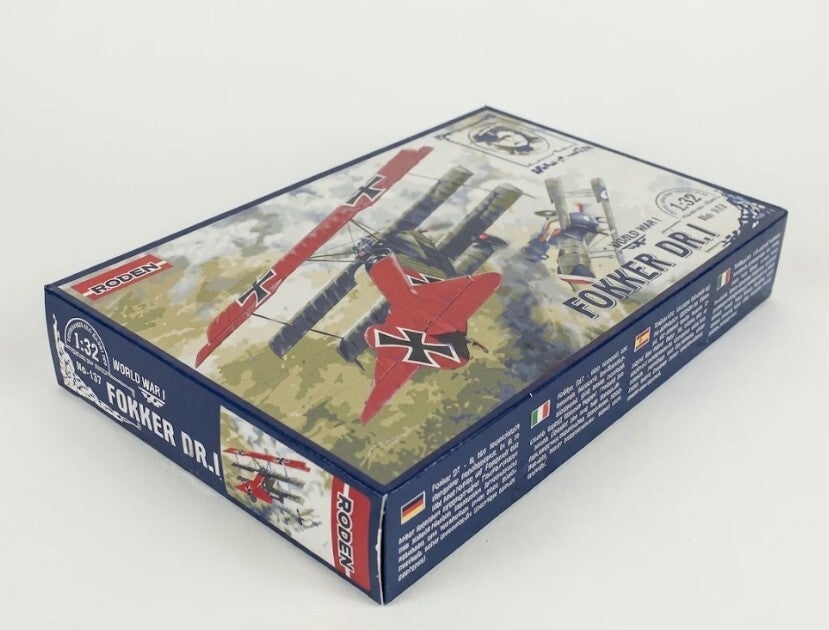
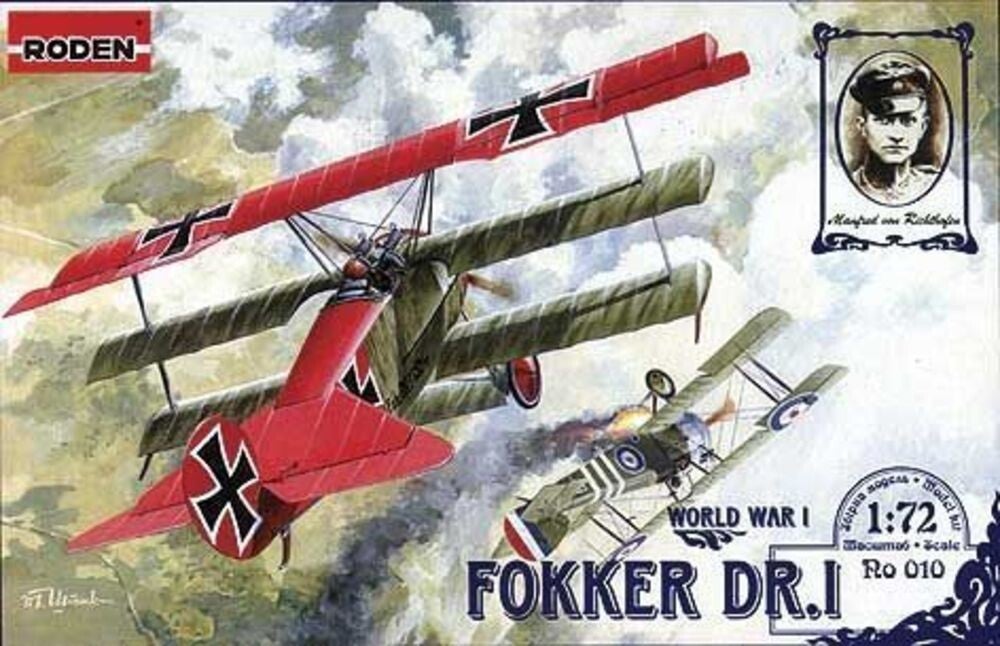
Fokker Dr.I 152/17 (w/n 1864).Fighter pilot - Manfred von Richtgofen
Holder of Pour le Merite Order ('Blue Max')
The picture shows an air fight of Manfred von Richtgofen with Elmer Ernest Heath, an English fighter pilot, a Lieutenant from 73rd Sq. of RFC. The air fight was on 13 March 1918 at 10:35 nearby Gonnelieu & Bauteux. Sopwith Camel B2523 of the Englishman was beaten down, but nevertheless heavily wounded fighter managed to survive. It was the 65th victory of famous German ace.
---
Histoire :
Le Fokker Dr.I, le chasseur allemand le plus célèbre de la Première Guerre mondiale, est passé à la postérité sous le nom d'« avion du Baron Rouge ». Le *Rittmeister* Manfred von Richthofen, l'as des as de la Grande Guerre, a remporté vingt de ses 80 victoires aériennes aux commandes de cet appareil. Bien qu'il ne soit pas considéré comme le meilleur avion de la Première Guerre mondiale, le Fokker *Dreidecker* (triplan) a eu le privilège d'être l'appareil le plus prisé par les as allemands.
L'apparition du Sopwith Triplane, début 1917, a offert un nouvel adversaire à l'Albatros D.III allemand. La société Fokker, qui travaillait alors sur un nouveau projet — le biplan D.VI —, reçut une commande de l'Idflieg (l'inspection de l'aviation militaire allemande) pour un nouvel appareil à trois ailes. Dans un premier temps, le commandement aérien allemand envisagea de copier le Sopwith Triplane (à l'instar de ce que Pfalz Flugzeugwerke avait fait précédemment avec les conceptions de Morane). Cependant, Anthony Fokker choisit rapidement d'adapter le D.VI en une configuration triplan. En août 1917, deux exemplaires de pré-série furent envoyés au front pour des essais en conditions réelles.
L'appareil reçut très vite des retours élogieux de la part de ses pilotes, notamment en raison de son incroyable maniabilité. Il fut rapidement intégré à la *Jagdgeschwader 1* (JG 1), une unité de chasse allemande d'élite surnommée le « Cirque volant de von Richthofen ». Cet avion se révélait idéal pour les combats à basse altitude.
En septembre 1917, la JG 1 fut confrontée à plusieurs accidents (des défaillances au niveau des ailes furent constatées) ; deux pilotes trouvèrent la mort, ce qui entraîna l'immobilisation au sol de tous les Dr.I pour les besoins d'une enquête. En réalité, le Dr.I était un appareil très exigeant, qui ne pardonnait pas la moindre erreur de pilotage. Lorsqu'il fut remis en service le mois suivant, il devint évident que le Dr.I ne pouvait plus rivaliser avec les nouveaux chasseurs alliés, bien plus puissants.
Au total, environ 300 exemplaires de ce type furent construits par la société Fokker, dont beaucoup restèrent en service jusqu'à la fin du conflit. Après la mort de von Richthofen lors d'un combat aérien le 21 avril 1918, le « Cirque volant » fut placé sous le commandement d'un autre as célèbre, Wilhelm Reinhardt (20 victoires, titulaire de la médaille « Pour le Mérite »). Deux mois plus tard, cependant, ce dernier trouva la mort dans un accident aérien alors qu'il pilotait le nouveau Dornier D.I. Le dernier commandant de la JG1 fut Hermann Göring (22 victoires, « Pour le Mérite »), qui occupa ce poste jusqu'à l'Armistice.
De nombreux autres as célèbres ont également piloté le Dr.I, notamment Ernst Udet (62 victoires, « Pour le Mérite »), Ulrich Neckel (30 victoires, « Pour le Mérite »), Erich Loewenhardt (53 victoires, « Pour le Mérite ») et Josef Carl Jacobs (41 victoires, « Pour le Mérite »).
Fokker Dr.I 152/17 (numéro de série 1864). Pilote de chasse : Manfred von Richthofen.
Titulaire de la médaille « Pour le Mérite » (surnommée « Blue Max »).
L'image illustre un combat aérien entre Manfred von Richthofen et Elmer Ernest Heath, un pilote de chasse britannique, lieutenant au sein du 73e escadron du RFC (Royal Flying Corps). L'affrontement eut lieu le 13 mars 1918 à 10 h 35, près de Gonnelieu et Bauteux. Le Sopwith Camel B2523 du pilote britannique fut abattu ; toutefois, ce dernier, bien que grièvement blessé, parvint à survivre. Il s'agissait de la 65e victoire du célèbre as allemand.
---
Sources : Roden Website.